
The Man Who Drew Balenciaga.

In post-war Paris, Alfredo Gonzalez sketched the designs of the great couturiers for Vogue, and was granted unique access to the reclusive genius Balenciaga. Now living in Australia, he recalls fashion’s golden age.

The Man Who Drew Balenciaga

Sunday Life | June, 22nd 2003

by Marion Hume

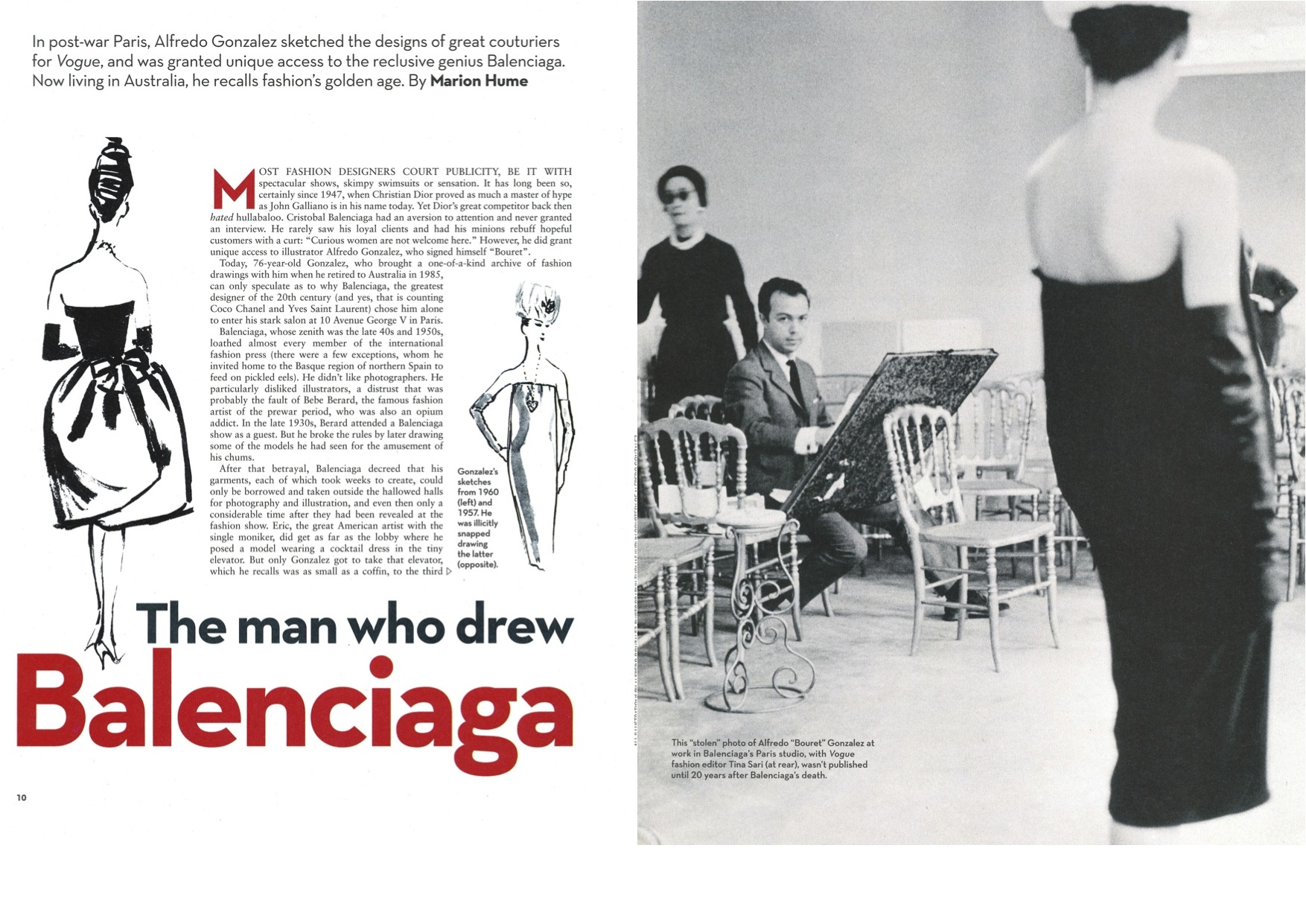
Most fashion designers court publicity, whether with spectacular shows,  skimpy swimsuits or sensation. It has long been so, certainly since 1947, when Christian Dior proved as much a master of hype as John Galliano is in his name today. Yet Dior’s great competitor back then hated hullabaloo. Cristobal Balenciaga never granted an interview. He rarely saw his loyal clients and had his minions rebuff hopeful customers with the curt: “Curious women are not welcome here.” However he did grant unique access to illustrator Alfredo Gonzalez, who signed himself “Bouret”.

Today, 76-year-old Gonzalez, who brought a one-of-a-kind archive of fashion drawings with him when he retired to Australia in 1985, can only speculate as to why Balenciaga, the greatest designer of the 20th century (and yes, that is counting Coco Chanel and Yves Saint Laurent) chose him alone to enter his stark salon at Number 10 Avenue George V in Paris.

Balenciaga, whose zenith was the late 40s and 1950s, almost loathed every member of the international fashion press (there were a few exceptions whom he invited home to the Basque region of northern Spain to feed on pickled eels). He didn’t like photographers. He particularly disliked illustrators; a distrust which was probably the fault of  Bebe Berard,  the famous fashion artist of  the pre-war period,  who was also an opium addict. In the late 1930s, Berard attended a Balenciaga show as a guest. But he broke the rules by later drawing some of the models he had seen for the amusement of his chums.

After that betrayal, Balenciaga decreed that his garments, each of which took weeks to create, could  only be borrowed and taken outside the hallowed halls for photography and illustration, and  even then only a considerable time after they had been revealed at the fashion show.  Eric, the great American artist with the single moniker, did get as far as the lobby where he posed a model wearing a  cocktail dress in the tiny elevator. But only Gonzalez got to take that elevator, which he recalls was as small as a coffin, to the third floor salon where models posed for him, and him alone, in Balenciaga’s rigourous creations.

Much has been surmised about the great Balenciaga. But it  is speculation. The remote and elusive master of unadorned, understated, refined creations rarely spoke. He never uttered a word to Alfredo Gonzalez, who only glimpsed him occasionally, through a doorway or reflected in the mirrors that lined the salon.   Gonzalez, the son of a school headmaster from Mexico City, dismisses any notion that Balenciaga, the son of a Spanish fisherman, might have liked him because they shared a mother tongue.  “I don’t think he even knew,”   says the artist who adopted “Bouret” from  a forefather who emigrated from France to Mexico in the grand days of the Mexican Empire.

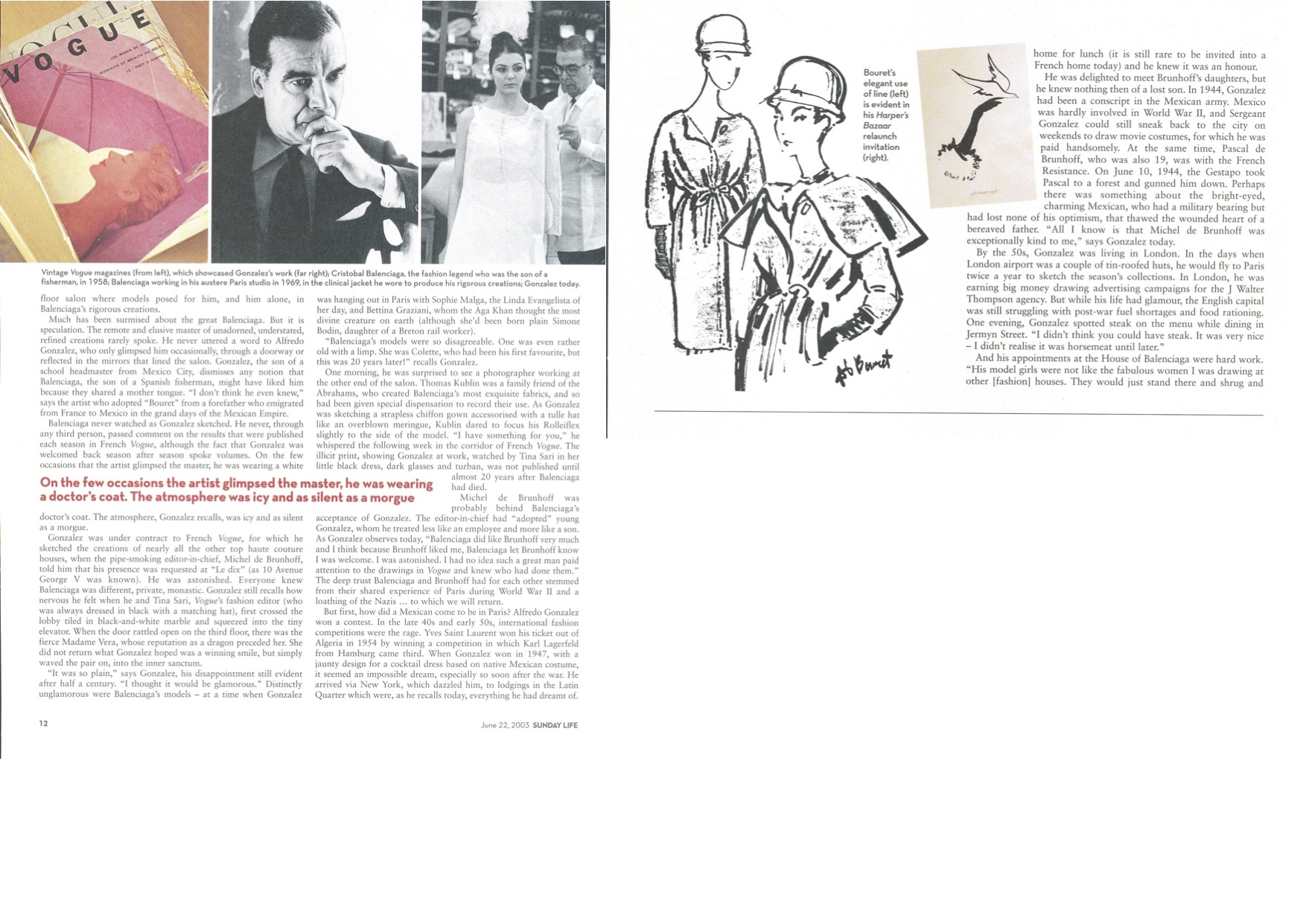
Balenciaga  never watched as Gonzalez sketched. He never, through any third person, passed comment on the results which were published each season in French Vogue, although the fact that Gonzalez was welcome back season after season  spoke volumes.  On the few occasions the artist glimpsed the master, he was wearing a doctor’s white coat.  The atmosphere, Gonzalez recalls, was icy and as silent as a morgue.

Gonzalez was under contract to French Vogue, for which he sketched the creations of nearly all the other top haute couture houses, when the pipe-smoking Editor-in-Chief, Michel de Brunhoff,  told him that his presence was requested at  “le dix” (as number 10, Avenue George V was known). He was astonished. Everyone knew Balenciaga was different, private, monastic. Gonzalez  still recalls how nervous he felt when he and  Tina Sari,  Vogue’s fashion editor (who was always dressed in black with a matching hat),  first crossed the lobby tiled in black and white marble and squeezed into the tiny elevator. When the door rattled open on the third floor, there was the fierce Madame Vera, whose reputation as a dragon proceeded her.  She did not return what Gonzalez hoped was a winning smile, but simply waved the pair on, into the inner sanctum.

“It was so plain,” says Gonzalez, his disappointment still evident after half a century. “ I thought it would be glamourous.”  Distinctly unglamorous were Balenciaga’s models-  at a time when Gonzalez was hanging out in Paris with Sophie Malga, the Linda Evangelista of her day, and Bettina Graziani, whom the Aga Khan thought the most divine creature on earth (although she’d been born plain Simone Bodin, the daughter of a Breton rail worker).

“Balenciaga’s models were so disagreeable. One was even rather old with a limp. She was Colette, who had been his first favourite, but this was twenty years later!” recalls Gonzalez.

One morning, he was surprised to see a photographer working at the other end of the salon. Thomas Kublin was a family friend of  the Abrahams, who created Balenciaga’s most exquisite fabrics and so had been given special dispensation to record their use. As Gonzalez was  sketching a strapless  chiffon gown accessorised with a tulle hat like an overblown meringue, Kublin dared to focus his Rolliflex slightly to the side of the model . ” I have something for you,” he whispered the following week in the corridor of  French Vogue. The illicit print, showing Gozalez  at work, watched by Tina Sari in her  little black dress, dark glasses and turban, was not published until almost 20 years after Balenciaga had died.

Michel de Brunhoff was probably behind Balenciaga’s acceptance of Gonzalez, whom the Editor-in-Chief had adopted  young Gonzalez who he treated  less like an employee, more like a son. As Gonzalez observes today,“Balenciaga did like Brunhoff very much and I think because Brunhoff liked me, Balenciaga let Brunhoff know I was welcome. I was astonished. I had no idea such a great man paid attention to the drawings in Vogue and knew who had done them.” The deep trust Balenciaga and Brunhoff had for one another stemmed from their shared experience of Paris during World War II and  a loathing of the Nazis…to which we will return.

But first, how a Mexican come to be in  Paris? Alfredo Gonzalez won a contest.  In the late 40s and early 50s, international fashion competitions were the rage. Yves Saint Laurent won his ticket out of Algeria in 1954 by winning a competition in which Karl Lagerfeld from Hamburg came third.  When Alfredo Gonzalez won in 1947,  with a jaunty design for a cocktail dress based on native Mexican costume, it seemed an impossible dream, especially so soon after the War. He arrived via New York, which dazzled him, to lodgings in the Latin Quarter which were, as he recalls today,  everything he had dreamed of. “I was up in the attic with the rooftops of Paris at my feet. It was all perfect – except of course there was no heating, no hot water and a shared bathtub. So I undressed and started to run the water and it was icy cold. Later on, I found out there was public douche [shower]  and I went every day. They thought I was mad. Then I got a bit French and went every other day, then every third day.”

Part of the prize was a job, but Gonzalez was disappointed to find it was sketching skiwear and bikinis. “We had no skiing at home  and Mexican ladies did not wear bikinis. I wanted to draw gowns,” Gonzalez explains.  So appointments were made with  the hot new talents of haute couture- Pierre Balmain and Christian Dior (the former had opened his couture house in 1945, the latter in 1947). Balmain offered Gonzalez an unwaged apprenticeship on the spot. When six months was up, Gonzalez was clearly too talented to go home. So Balmain introduced him to Brunhoff, who gave him four pages to draw for the next edition of Vogue.

Gonzalez flung himself into the Post-War Paris  of glamourous South American heiresses in diamonds,  doe-eyed model girls and movie stars. He spied Ingrid Bergman and met Larry Olivier and Vivien Leigh over cocktails. To his lasting regret, he did not dance with Marlene  Dietrich (although he would later become firm friends with both Claudette Colbert and Bette Davies). “Marlene said she was too tired. But those legs! They were exquisite. She was a knock out,”  he recalls. The hip drink back then was a dry martini, or four and when Gonzalez eventually  took a vacation home to Mexico, “my Aunt Maria said, ‘Who are these Martinis people you are always talking about?’ Anyway she didn’t approve. She liked whisky better.”

Every fashion season, he was sent to Rochas, Jacques Fath, Balmain and Dior  as well as Balenciaga, to draw for French Vogue. But  he was not sent  to  Coco Chanel when she reopened her house in 1954. Michel de Brunhoff did not attend Chanel’s shows and they were not mentioned at all by French Vogue until the magazine bowed to pressure from its American sister publication, which wanted Chanel’s advertising dollars.  The reasons for the snubbing were not discussed, but they were understood. Those who had lived through haute couture’s own war had not forgotten Throughout World War II, Coco Chanel lived with a Nazi at Le Ritz, which was flying the swastika.  Balenciaga meanwhile had closed his House, then reopened it to stop the Nazis requisitioning the building. Although the couturier had originally left Spain to come to Paris because he was anti-fascist, the Nazis tolerated him because the Spanish leader General Franco was pro-Hitler.

Meanwhile, couturier Lucien Lelong, a big name in the 40s, was trying to persuade the Reich not to relocate fashion’s capital to Berlin. Michel de Brunhoff remained nominally in charge of French Vogue whose studios were uses by the Nazis for the creation of propaganda . They never discovered the false wall behind which he had concealed records and cameras. Nor did they discover that the brother of Jean de Brunhoff, who created Babar the Elephant, had his own artistic talents, which he used to forge  baptism papers for Jewish staff and their families.

When Gonzalez first met Brunhoff just three years after the end of the War,  his French was not yet fluent. Brunhoff invited him home for lunch, (it is still rare to be invited into a French home today) and he knew it was an honour. He was delighted to meet Brunhoff’s daughters, but he knew nothing then of a lost son. In 1944, Gonzalez had been a conscript in the Mexican army. Mexico was hardly involved in World War II, and Sergeant Gonzalez could still sneak back to the city on weekends to draw movie costumes for which he was paid handsomely. At the same time, Pascal de Brunhoff, who was also 19, was with the French resistance. On 10th June 1944,  the Gestapo took Pascal to a forest and gunned him down. Perhaps there was something about the bright eyed, charming Mexican, who had military bearing but had lost none of his optimism, that thawed the wounded heart of a bereaved father.  “All I know is that Michel de Brunhoff was exceptionally kind to me,”  says Gonzalez today.

By the 50s, Gonzalez was living in London. In the days when London Airport was a couple of tin roofed huts, he would fly to Paris twice a year to sketch the season’s collections. In London, he was earning big money drawing advertising campaigns for the J Walter Thompson agancy. But while his life had glamour, the British capital was still struggling with fuel shortages and food rationing. One evening, Gonzalez spotted steak on the menu while dining in Jermyn Street. “I didn’t think you could have steak. It was very nice – I didn’t realise it was horsemeat until later.”

And his appointments at the House of  Balenciaga were hard work.  “His model girls were not like the fabulous women I was drawing at other [fashion] houses.  They would just stand there and  shrug and assume a bored expression. There was nothing nice about them. “ recalls Gonzalez as he leafs though pages of vintage Vogue magazines in his Sydney studio. “I had to fight very hard to make a sketch – look at the arms here – it probably took all the charm in the world to make the girl pose. I could have done better drawings, I think. They became just a basic description of a dress rather than a fashion drawing. That is what Balenciaga wanted of course.”

Balenciaga closed his doors in 1968, declaring there was no one left  worth dressing. Mona Bismarck,  who started life as  the daughter of a Kentucky stable manager and ended up a countess living in a hilltop house in Capri, couldn’t leave the house for three days after hearing the news.

Alfredo Gonzalez had already moved on. For decades, photography and illustration had existed side by side in glossy magazines. By now,  it was clear which would have supremacy. Gonzalez even bought himself a camera.  “But I didn’t like photography, it was not for me.” Instead, he had taken an interest in the London shop of John Cavanagh, the designer he had known since they were both juniors at  Balmain. Gonzalez had started to bring things back from trips to Mexico for the shop. He had also been flattered when a series of his Mexican drawings had inspired a collection by a very young  Italian called Valentino Garavani, who was working for Jean Desses. Few remember Desses today, but his apprentice became known simply as Valentino.

Gonzalez decided to import  peasant shirts and other Mexican wear and Mexicana, the store, was born. Over the next  twenty years, his customers included Princess Margaret, Princess Anne and Diana, Princess of Wales.

The first Mexicana , in London’s Pimlico, inspired a second in Sydney, which Gonzalez first saw in 1968 on a trip to Australia with Melbournian Lex Aitken, an acclaimed interior designer and Gonzalez’s partner for more than 40 years.  Mexicana Sydney, at Rose Bay, was short lived; (1969-1972),  but Gonzalez was charmed by its customers. “They were so fresh and daring. My London clients were always a little afraid of what their husbands would think. Here  they didn’t care! They were hungry for new things and beautiful with an elegance they didn’t know they had.”

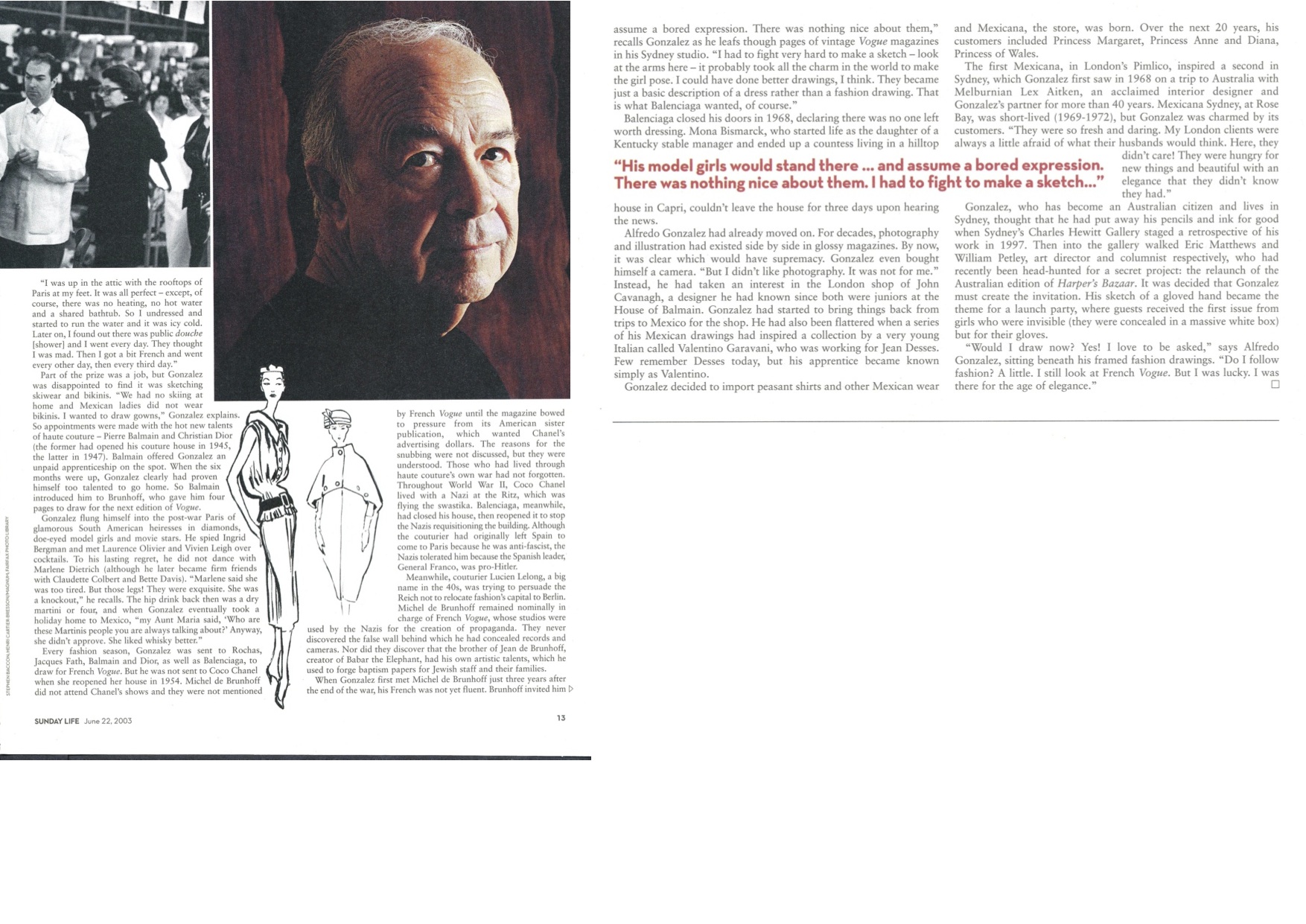
Gonzalez, who has become an Australian citizen and lives in Sydney, thought he had put away his pencils and ink for good when Sydney’s Charles Hewitt Gallery staged a retrospective of his work in 1997. Then into the gallery walked Eric Matthews and William Petley, art director and  columnist respectively,  who had been recently head hunted for a secret project: the relaunch of the Australian edition of Harper’s Bazaar. It was decided that  Gonzalez must create the invitation. His sketch of gloved hands became the theme for a launch party, where guests received the first issue from girls who were invisible (they were concealed in a massive white box), but for  their gloves.

“Would  I draw now? Yes! I love to be asked,” says Alfredo Gonzalez as he sits beneath his framed fashion drawings.  “Do I follow fashion? A little. I still look at French Vogue. But  I was lucky. I was there for the age of elegance.”