The House that Soared, A Rare look Inside the Mansion of Martin Margiela


TANK | 2007

The House That Soared, A Rare Look Inside the Mansion of Martin Margiela

by Marion Hume
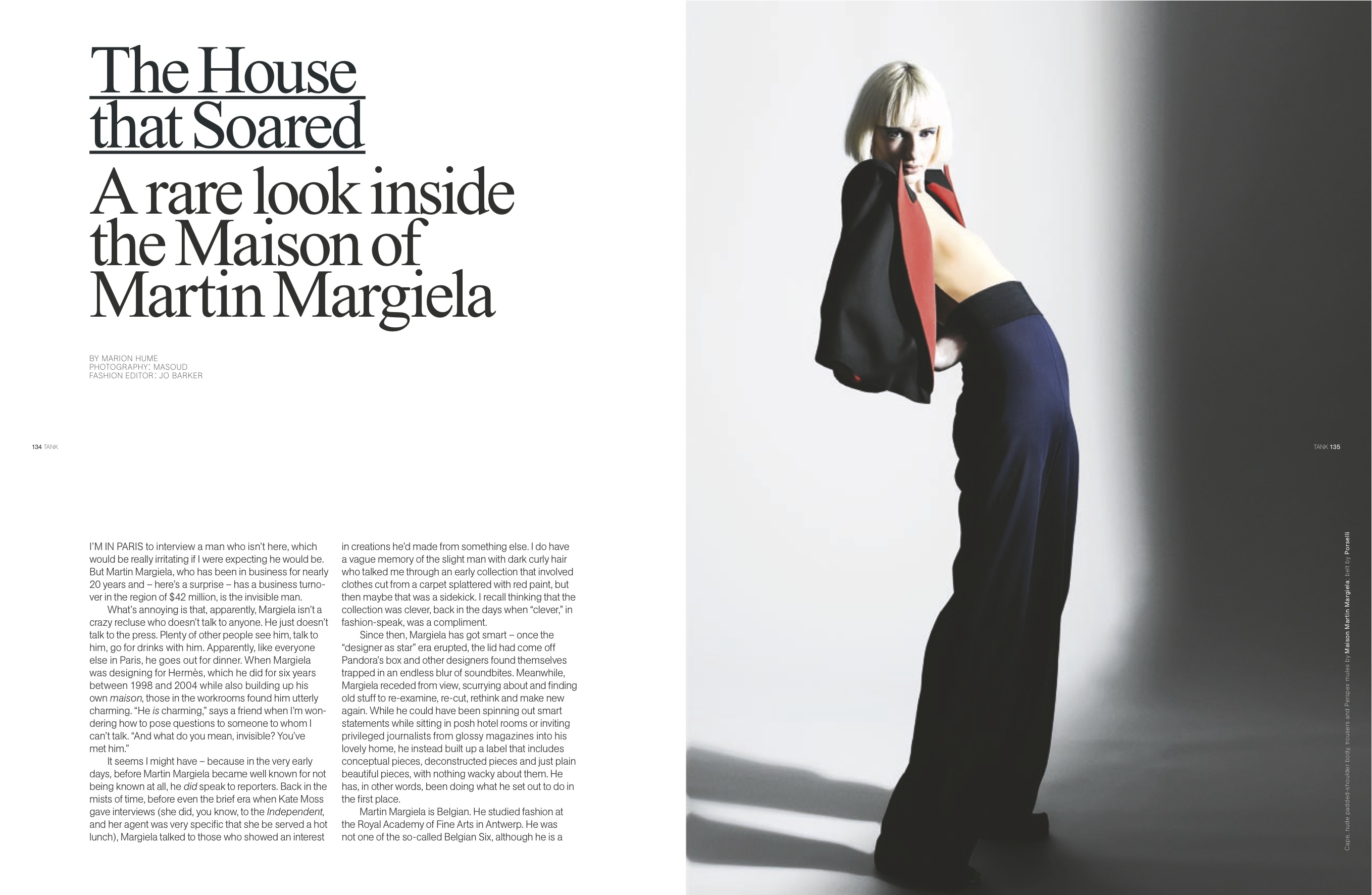
I’m In ParIs to interview a man who isn’t here, which would be really irritating if I were expecting he would be. But Martin Margiela, who has been in business for nearly 20 years and – here’s a surprise – has a business turnover in the region of $42 million, is the invisible man.
What’s annoying is that, apparently, Margiela isn’t a crazy recluse who doesn’t talk to anyone. He just doesn’t talk to the press. Plenty of other people see him, talk to him, go for drinks with him. apparently, like everyone else in Paris, he goes out for dinner. When Margiela was designing for Hermès, which he did for six years between 1998 and 2004 while also building up his own maison, those in the workrooms found him utterly charming. “He is charming,” says a friend when I’m won-dering how to pose questions to someone to whom I can’t talk. “and what do you mean, invisible? You’ve met him.”
It seems I might have – because in the very early days, before Martin Margiela became well known for not being known at all, he did speak to reporters. Back in the mists of time, before even the brief era when Kate moss gave interviews (she did, you know, to the Independent, and her agent was very specific that she be served a hot lunch), Margiela talked to those who showed an interest since then, Margiela has got smart – once the “designer as star” era erupted, the lid had come off Pandora’s box and other designers found themselves trapped in an endless blur of soundbites. Meanwhile, Margiela receded from view, scurrying about and finding old stuff to re-examine, re-cut, rethink and make new again. While he could have been spinning out smart statements while sitting in posh hotel rooms or inviting privileged journalists from glossy magazines into his lovely home, he instead built up a label that includes conceptual pieces, deconstructed pieces and just plain beautiful pieces, with nothing wacky about them. He has, in other words, been doing what he set out to do in the first place.
Martin Margiela is Belgian. He studied fashion at the Royal Academy of Fine Arts in Antwerp. He was not one of the so-called Belgian six, although he is a contemporary of Dries Van Noten, Ann Demeulemeester and the others. He moved to Paris and from 1984 to 1987 was a design assistant for Jean Paul Gaultier – and, interestingly, many years later it was Gaultier who replaced him when he chose to leave Hermès. apparently, the two get on well to this day.
Maison Martin Margiela is in the 11th arrondissement of Paris, an area that still has the tired, grubby air of the familiar picture-postcard images. There’s an un-marked door and inside, all is white. In the lobby sits a caravan, lit up and twinkling, yet the doorway is small. How on earth did it get in here?
I am met by a girl in a white coat–in this matte-white world, everything is painted or swathed in white – handed a pair of white gloves and ushered further inside, to a pitch-black room. The girl in the white coat, who I now cannot see at all, turns on a torch and shines it at my feet. suddenly a man appears behind glass, only his torso visible, and a fruity voice announces, “a shopping bag as a trench coat.” The room darkens again, and then another headless figure is illuminated. “sneakers, opened and assembled as a waistcoat,” says Mr. Fruity. next, a bathrobe made of hotel towels is lit up. “We don’t steal them,” says the girl with the torch.
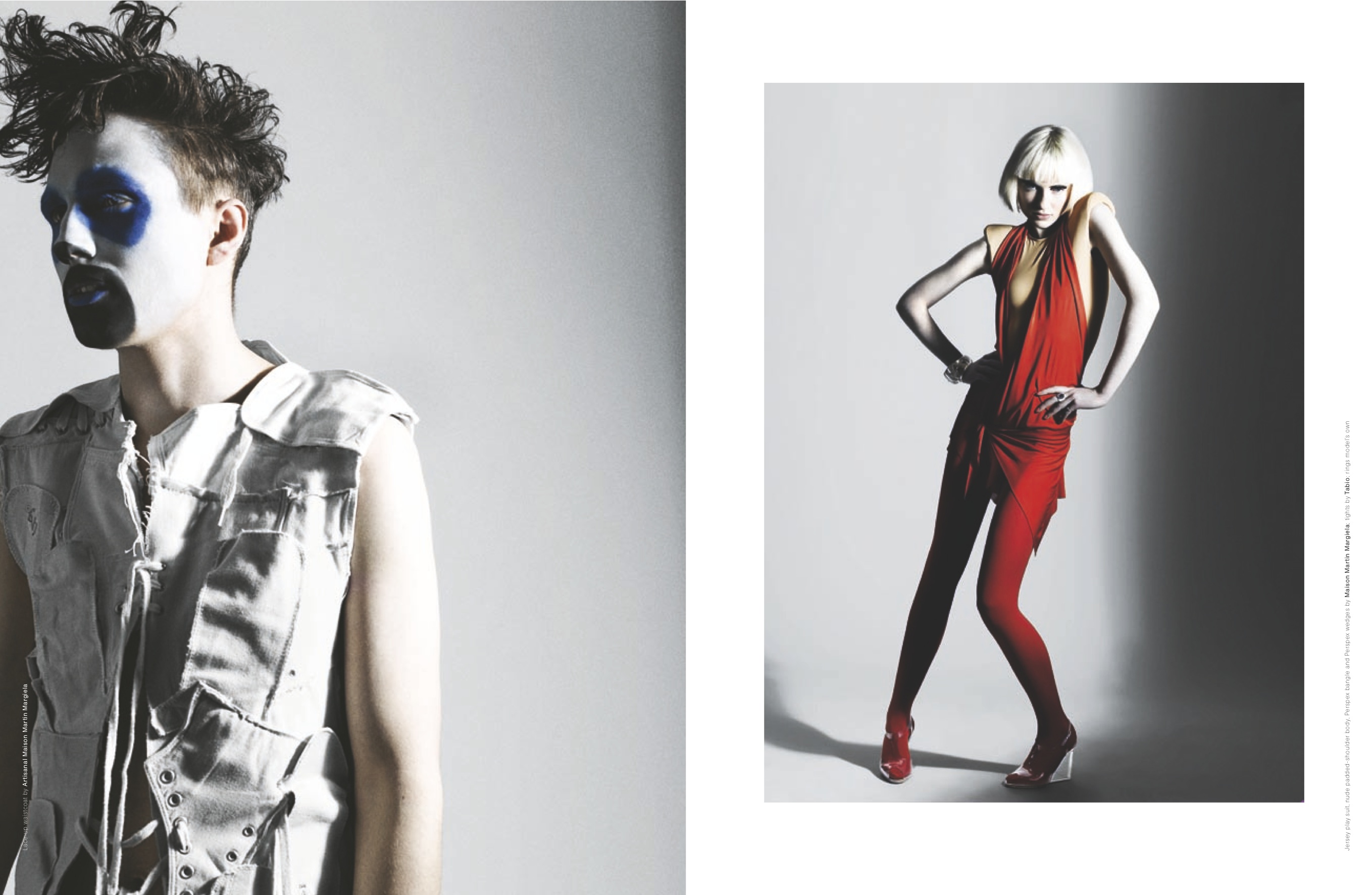
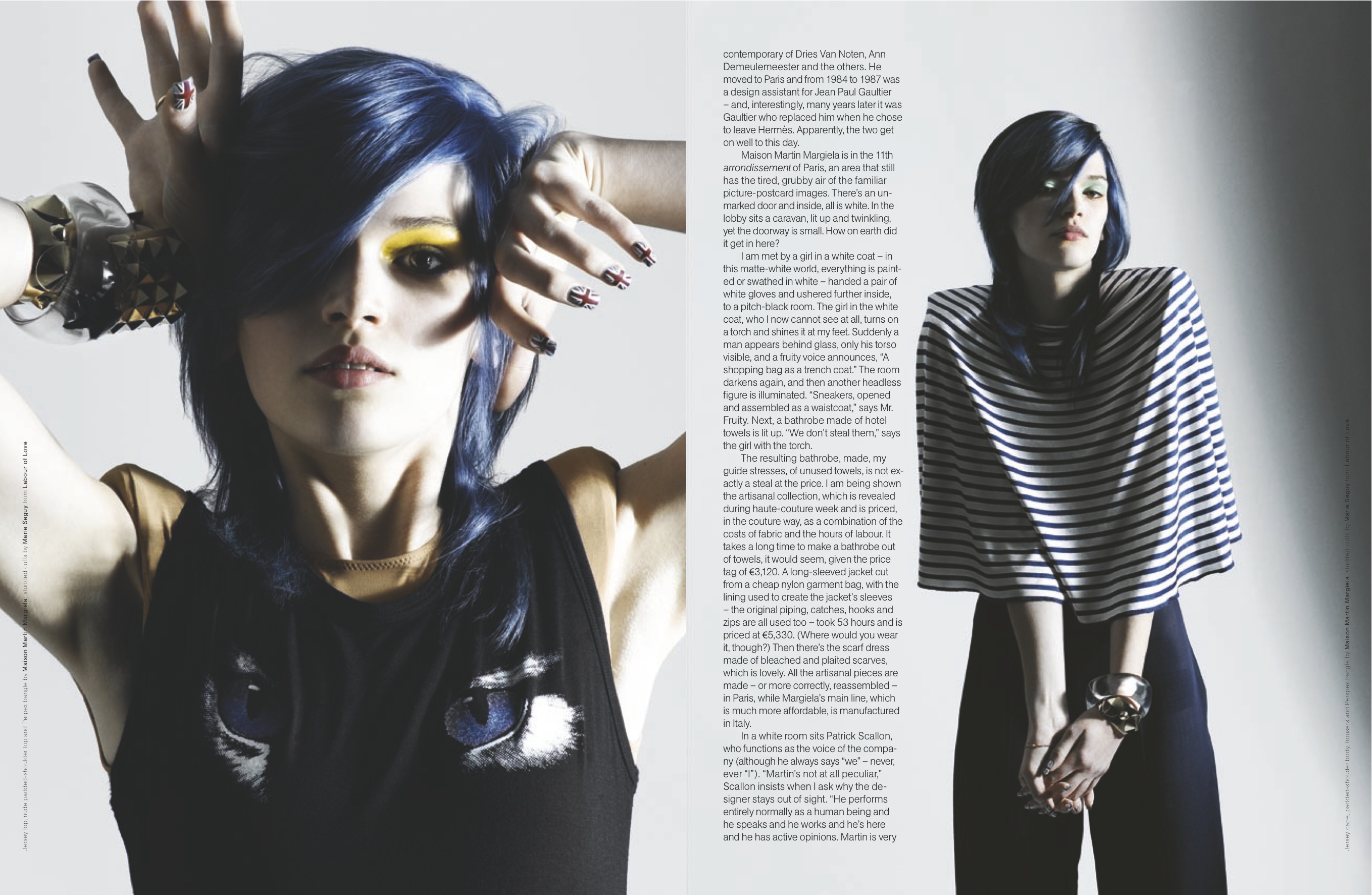
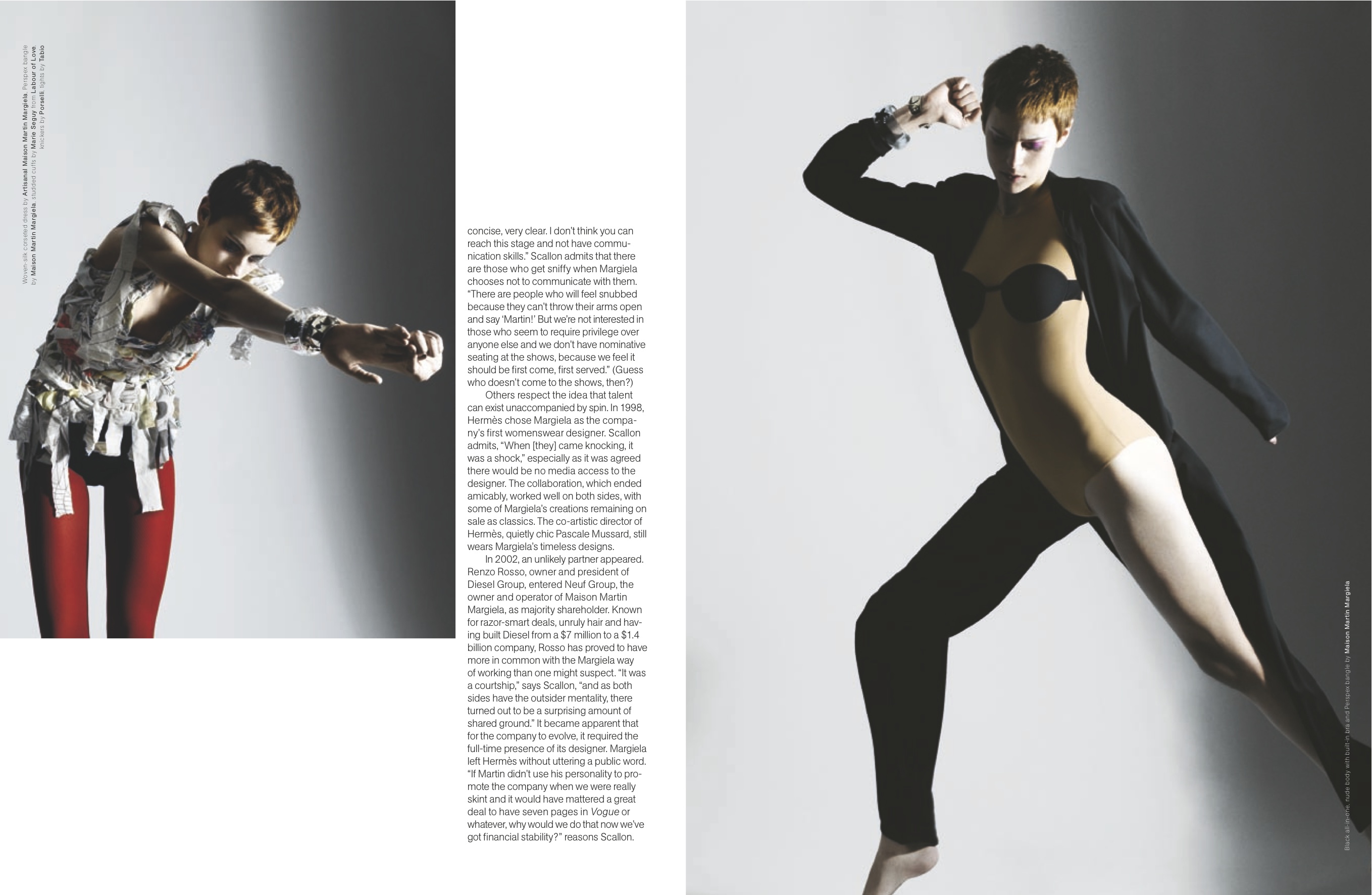
The resulting bathrobe, made, my guide stresses, of unused towels, is not exactly a steal at the price. I am being shown the artisanal collection, which is revealed during haute-couture week and is priced, in the couture way, as a combination of the costs of fabric and the hours of labour. It takes a long time to make a bathrobe out of towels, it would seem, given the price tag of €3,120. a long-sleeved jacket cut from a cheap nylon garment bag, with the lining used to create the jacket’s sleeves – the original piping, catches, hooks and zips are all used too – took 53 hours and is priced at €5,330. (Where would you wear it, though?) Then there’s the scarf dress made of bleached and plaited scarves, which is lovely. all the artisanal pieces are made – or more correctly, reassembled – in Paris, while Margiela’s main line, which is much more affordable, is manufactured in Italy.
In a white room sits Patrick Scallon, who functions as the voice of the company (although he always says “we” – never, ever “I”). “Martin’s not at all peculiar,” Scallon insists when I ask why the de- signer stays out of sight. “He performs entirely normally as a human being and he speaks and he works and he’s here and he has active opinions. Martin is very
concise, very clear. I don’t think you can reach this stage and not have commu- nication skills.” Scallon admits that there are those who get sniffy when Margiela chooses not to communicate with them. “There are people who will feel snubbed because they can’t throw their arms open and say ‘Martin!’ But we’re not interested in those who seem to require privilege over anyone else and we don’t have nominative seating at the shows, because we feel it should be first come, first served.” (Guess who doesn’t come to the shows, then?)
Others respect the idea that talent can exist unaccompanied by spin. In 1998, Hermès chose Margiela as the company’s first womenswear designer. Scallon admits, “When [they] came knocking, it was a shock,” especially as it was agreed there would be no media access to the designer. The collaboration, which ended amicably, worked well on both sides, with some of Margiela’s creations remaining on sale as classics. The co-artistic director of Hermès, quietly chic Pascale Mussard, still wears Margiela’s timeless designs.
In 2002, an unlikely partner appeared. Renzo Rosso, owner and president of Diesel Group, entered Neuf Group, the owner and operator of maison Martin Margiela, as majority shareholder. Known for razor-smart deals, unruly hair and hav- ing built Diesel from a $7 million to a $1.4 billion company, Rosso has proved to have more in common with the Margiela way of working than one might suspect. “It was a courtship,” says Scallon, “and as both sides have the outsider mentality, there turned out to be a surprising amount of shared ground.” It became apparent that for the company to evolve, it required the full-time presence of its designer. Margiela left Hermès without uttering a public word. “If Martin didn’t use his personality to pro-mote the company when we were really skint and it would have mattered a great deal to have seven pages in Vogue or whatever, why would we do that now we’ve got financial stability?” reasons Scallon.
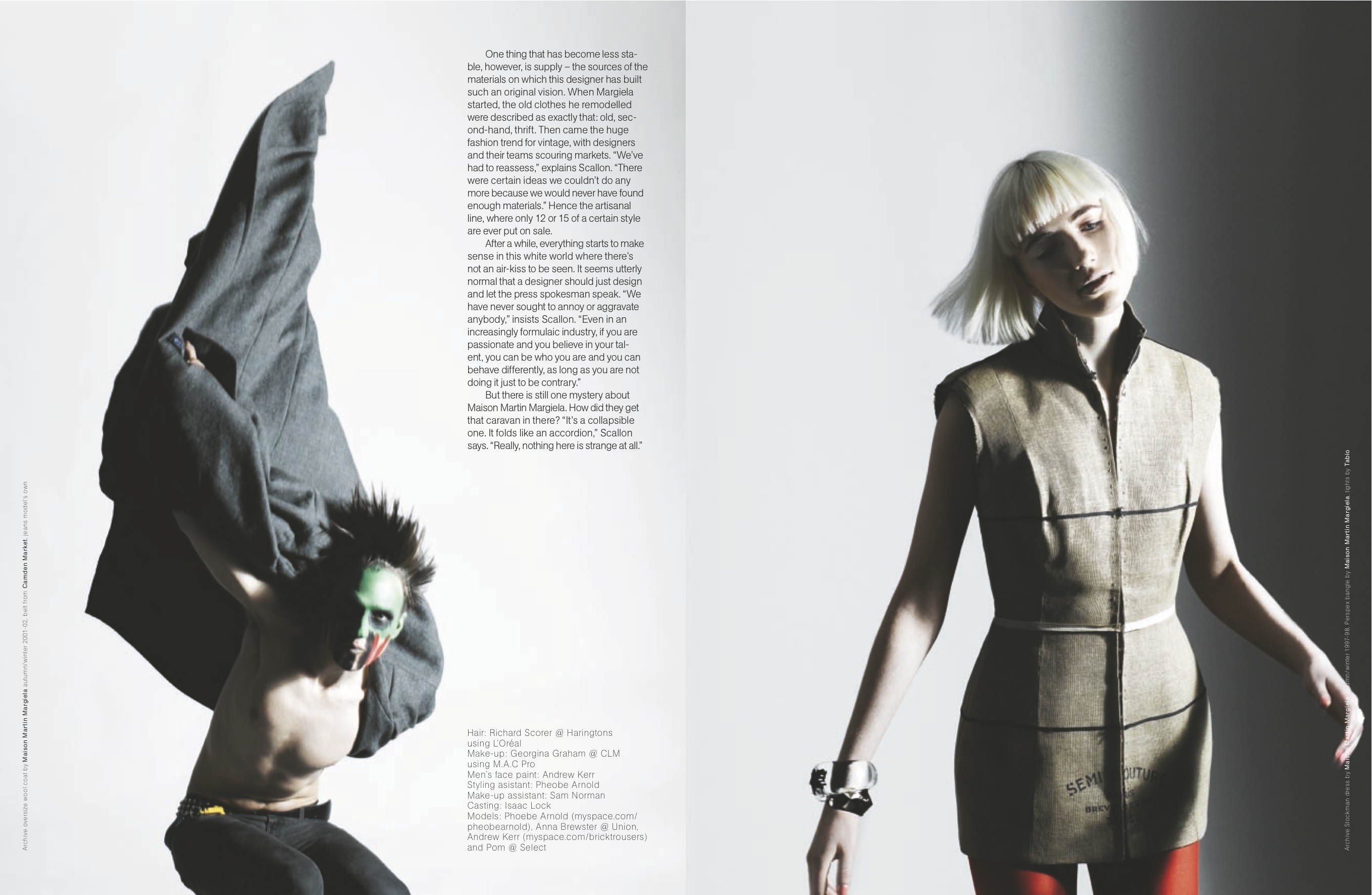
One thing that has become less stable, however, is supply – the sources of the materials on which this designer has built such an original vision. When Margiela started, the old clothes he remodelled were described as exactly that: old, second-hand, thrift. Then came the huge fashion trend for vintage, with designers and their teams scouring markets. “We’ve had to reassess,” explains Scallon. “There were certain ideas we couldn’t do any more because we would never have found enough materials.” Hence the artisanal line, where only 12 or 15 of a certain style are ever put on sale.
After a while, everything starts to make sense in this white world where there’s not an air-kiss to be seen. It seems utterly normal that a designer should just design and let the press spokesman speak. “We have never sought to annoy or aggravate anybody,” insists Scallon. “Even in an increasingly formulaic industry, if you are passionate and you believe in your talent, you can be who you are and you can behave differently, as long as you are not doing it just to be contrary.”
But there is still one mystery about maison Martin Margiela. How did they get that caravan in there? “It’s a collapsible one. It folds like an accordion,” Scallon says. “really, nothing here is strange at all.”