TIME
By Marion Hume Thursday, Nov. 15, 2007
The Ferragamo family built its fortunes on shoes, but the tight-knit clan is stepping boldly into a new era, with a new managing director and plans for a public offering.
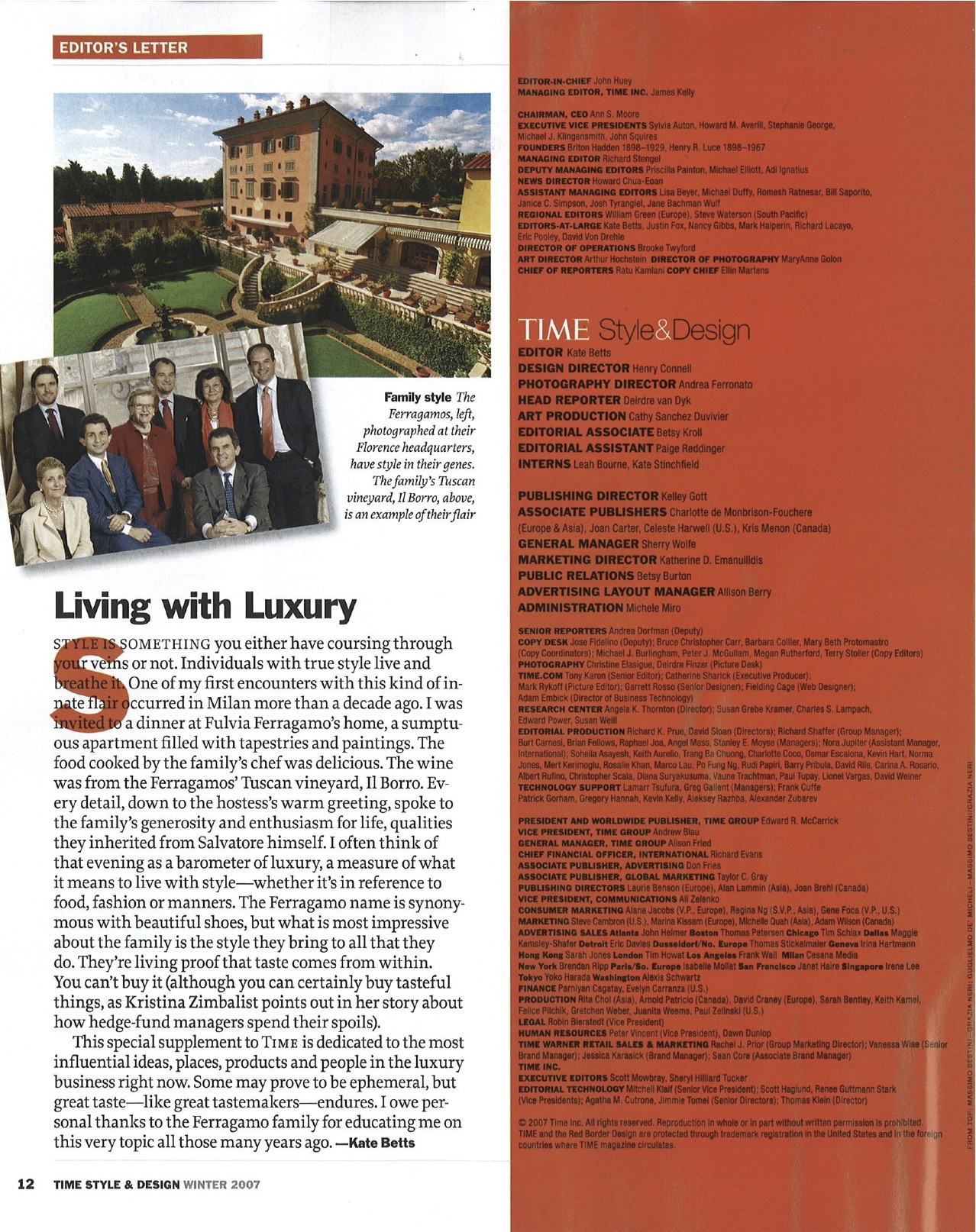
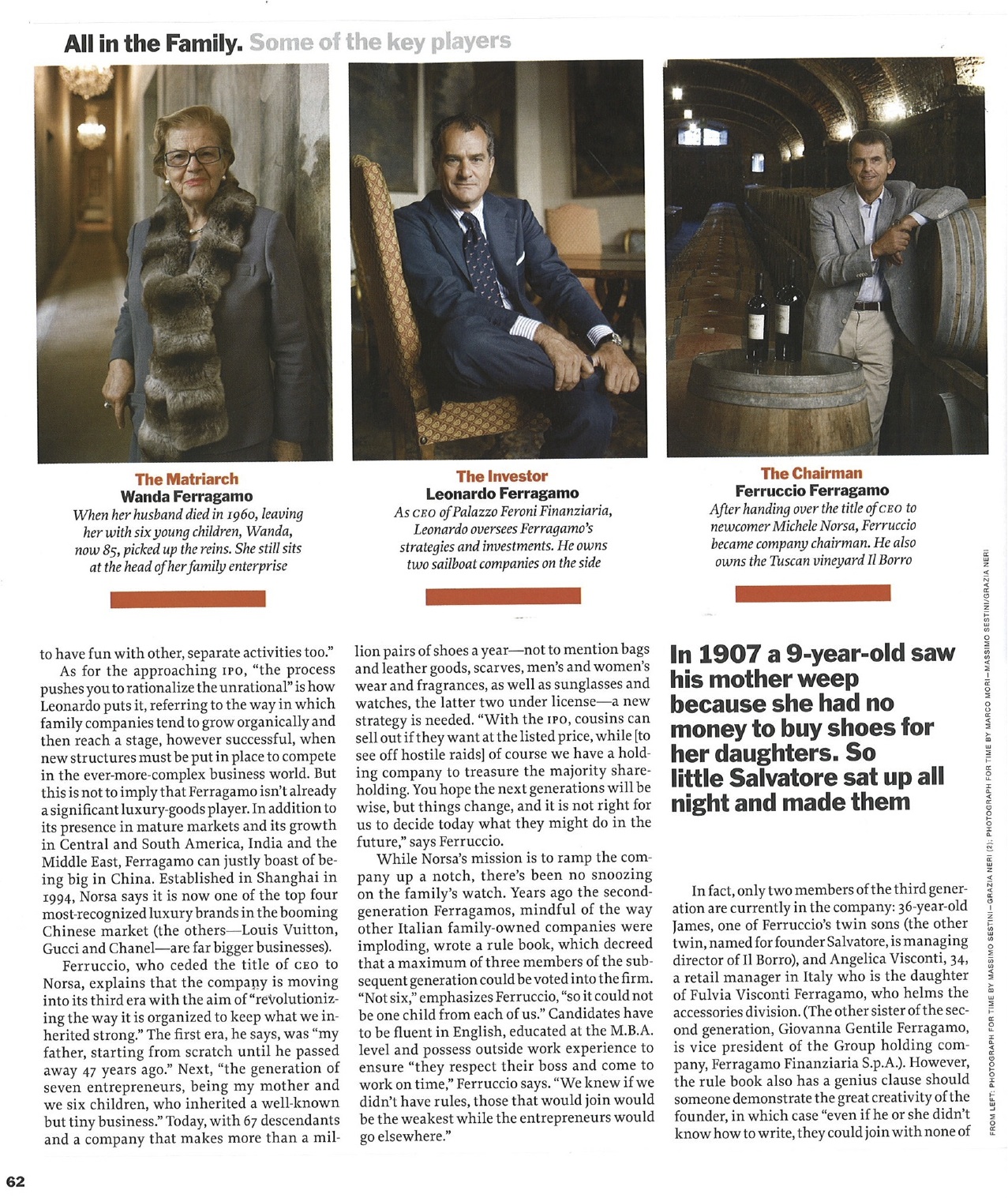
Meet Mrs. Wanda, Mr. Ferruccio, Mr. Massimo, Mr. Leonardo, Mr. James.In the Florentine medieval palazzo that is the world headquarters of Salvatore Ferragamo, only one key executive is referred to by using his surname. This is because Michele Norsa, CEO and Group Managing Director, is the first outsider to hold a leading managerial position in this family firm. To avoid confusion in the sumptuous surroundings where the company has been based since 1938, it’s easier if all the Ferragamos are referred with a Mr. or Mrs. in front of their first names.
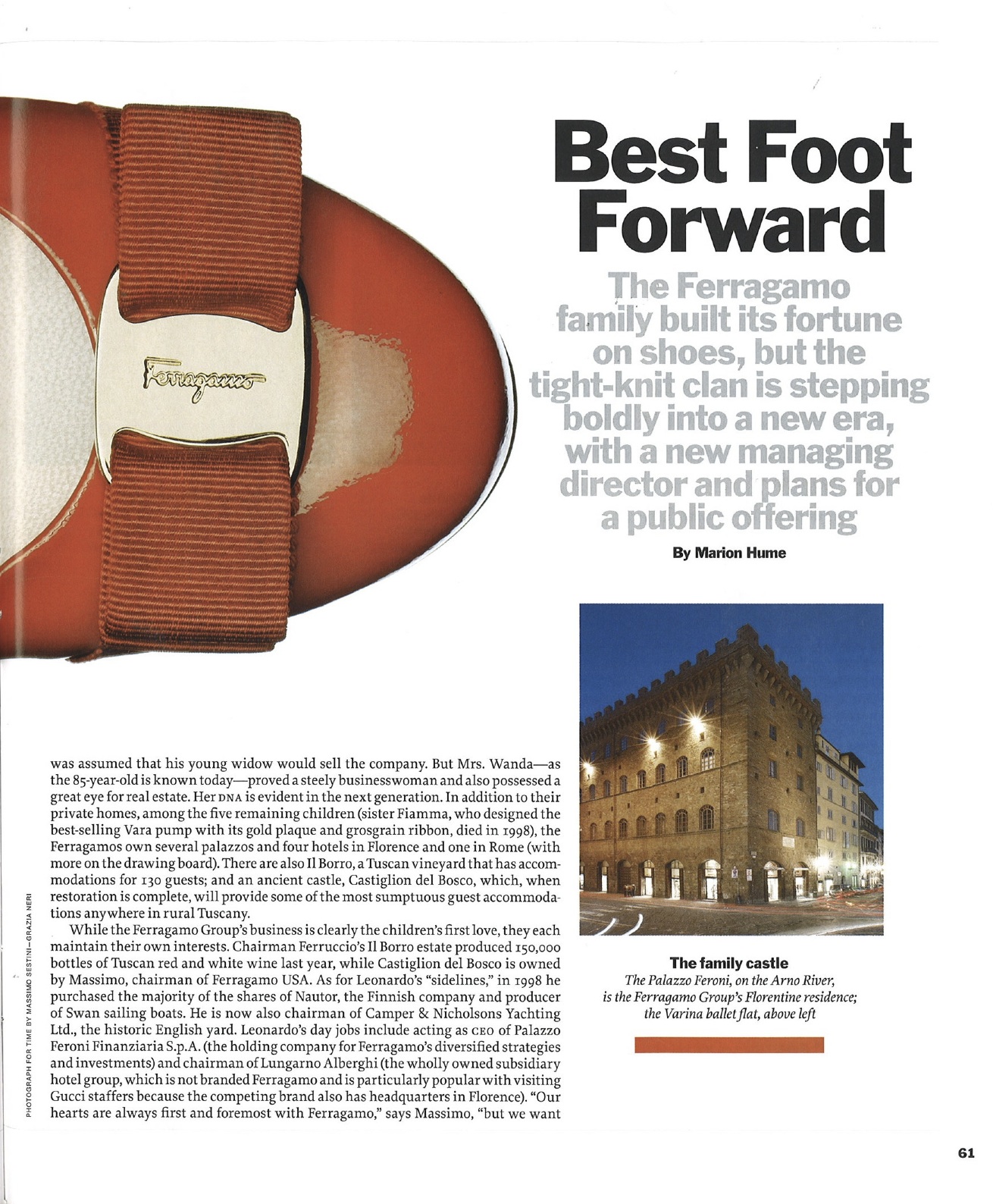
The Ferragamo clan are a united bunch and are in agreement that now is a time for change. The company is gearing up for an IPO next year with Norsa, who was most recently the CEO of Valentino, here to put in place the professional structure that this requires. The product range is expanding, there’s a new ready-to-wear designer on board (the Spaniard, Cristina Ortiz, who is ex-Prada and Brioni) and a schedule of store openings is slated for the US and Europe as well as the emerging markets like China and Russia. But the soul of the business is, and will remain, the shoes on which this company’s fortunes were founded. “Of course, the shoe business may not be as attractive as our handbags from a shareholder’s point of view because of sizes and a smaller initial mark-up,” says James, the director of women’s leather goods. “But at our core are beautifully-crafted shoes. While today, the word luxury is being used for everything from toilet paper to cars, we talk about things that are unique to us”. His uncle, Leonardo, who oversees the financial side of the group, puts it thus; “It’s not difficult to expand when you have a product that is respected and appreciated.”
The product has come a long way since the family patriarch first fell in love with shoes. The history is this: In 1907, a nine-year-old boy, the eleventh of fourteen children in a peasant family, saw his mother weep because she had no money to buy First Communion shoes for two of her daughters. So little Salvatore sat up all night and made them. By thirteen, he had his own shoemaking business and by his early twenties, he was in Hollywood, making shoes for the stars of the silver screen. He returned to his homeland in 1927 in search of the “made in Italy” level of craftsmanship on which the company still depends – and which he applied to shoes which bore his name once he could no longer make every single pair with his own hands. Although this enterprise initially drove him to bankruptcy, Salvatore rose again to become the shoemaker of choice to Ava Gardner, Eva Peron and Greta Garbo.
When Salvatore Ferragamo died suddenly in 1960 leaving six children, it was assumed that his young widow would sell up. But Mrs. Wanda – as the 85-year-old is known today – proved a steely businesswoman and also possessed of a great eye for real estate. Her DNA is clear in the next generations. As well as their private homes, the Ferragamos between them own several palazzos for rent; four hotels in Florence and one in Rome (with more on the drawing board); a vineyard estate called Il Borro which also has characterful accommodation for 130 guests; and an ancient castle, Castiglion del Bosco, which, when restoration is complete, will provide some of the most sumptuous guest accommodation anywhere in rural Tuscany.
While the Ferragamo Group’s business is clearly the children’s first love, they each also does their own thing. Chairman, Ferruccio’s Il Borro produced 150,000 bottles of Tuscan red and white wine last year, while Castiglion del Bosco is owned by Massimo, chairman of Ferragamo USA. As for Leonardo’s “sidelines, in 1998, he purchased the majority of the shares of Nautor, the Finnish company and producer of Swan sailing boats. He is now also chairman of Camper & Nicholsons Yachting Ltd, the English historic yard. Leonardo’s day jobs include acting as CEO of Palazzo Feroni Finanziaria S.p.A (the holding company for Ferragamo’s diversified strategies and investments) and chairman of Lungarno Alberghi, (the wholly-owned subsidiary hotel group, which is not branded Ferragamo and is particularly popular with visiting Gucci staffers, given the competitive company is also headquartered in Florence). “Our hearts are always first and foremost with Ferragamo,” says Massimo, “but we want to have fun with other, separate activities too.”
As for the approaching IPO, “the process pushes you to rationalize the unrational” is how Leonardo puts it, referring to how family companies tend to grow organically and then reach a stage, however successful, when new structures must be put in place to compete in the ever-more complex business world. But this is not imply that Ferragamo isn’t already a significant world player. As well as its presence in the mature markets and its growth in Central and South America, India and The Middle East, Ferragamo can justly boast of being big in China. Established in Shanghai since 1994, it is one of the top four most-recognized luxury brands in the booming Chinese market, (the others – Louis Vuitton, Gucci and Chanel – are far bigger businesses).
Ferruccio, who ceded the title of CEO to Norsa, explains the company is moving into its third era with the aim of “revolutionizing the way it is organized to keep what we inherited strong.” The first era, was, he says, “my father, starting from scratch until he passed away 47 years ago.” Next, “the generation of seven entrepreneurs being my mother and we six children who inherited a well-known but tiny business.” Today, with 67 descendants and a company which makes more than a million pairs of shoes a year – not to mention bags and leather goods, scarves, men’s and women’s wear and fragrance as well as sunglasses and watches, the latter two under license – a new shift is needed. “With the IPO, cousins can sell out if they want at the listed price, while (to see off hostile raids) of course we have a holding company to treasure the majority shareholding. You hope the next generations will be wise, but things change and it is not right for us to decide today what they might do in the future,” says Ferruccio.
While Norsa’s remit is to ramp the company up a notch, there’s been no snoozing on the family’s watch. Years ago, being mindful of the way other Italian family companies were imploding, the second generation Ferragamos wrote their own rule book, which decreed that only a maximum of three of the subsequent generation could be voted into the family firm. “Not six,” emphasizes Ferruccio, “so it could not be one child from each of us.” Candidates have to be fluent in English, possessed of an MBA and have to have worked elsewhere to ensure “they respect their boss and come to work on time. We knew if we didn’t have rules, those that would join would be the weakest while the entrepreneurs would go elsewhere.”
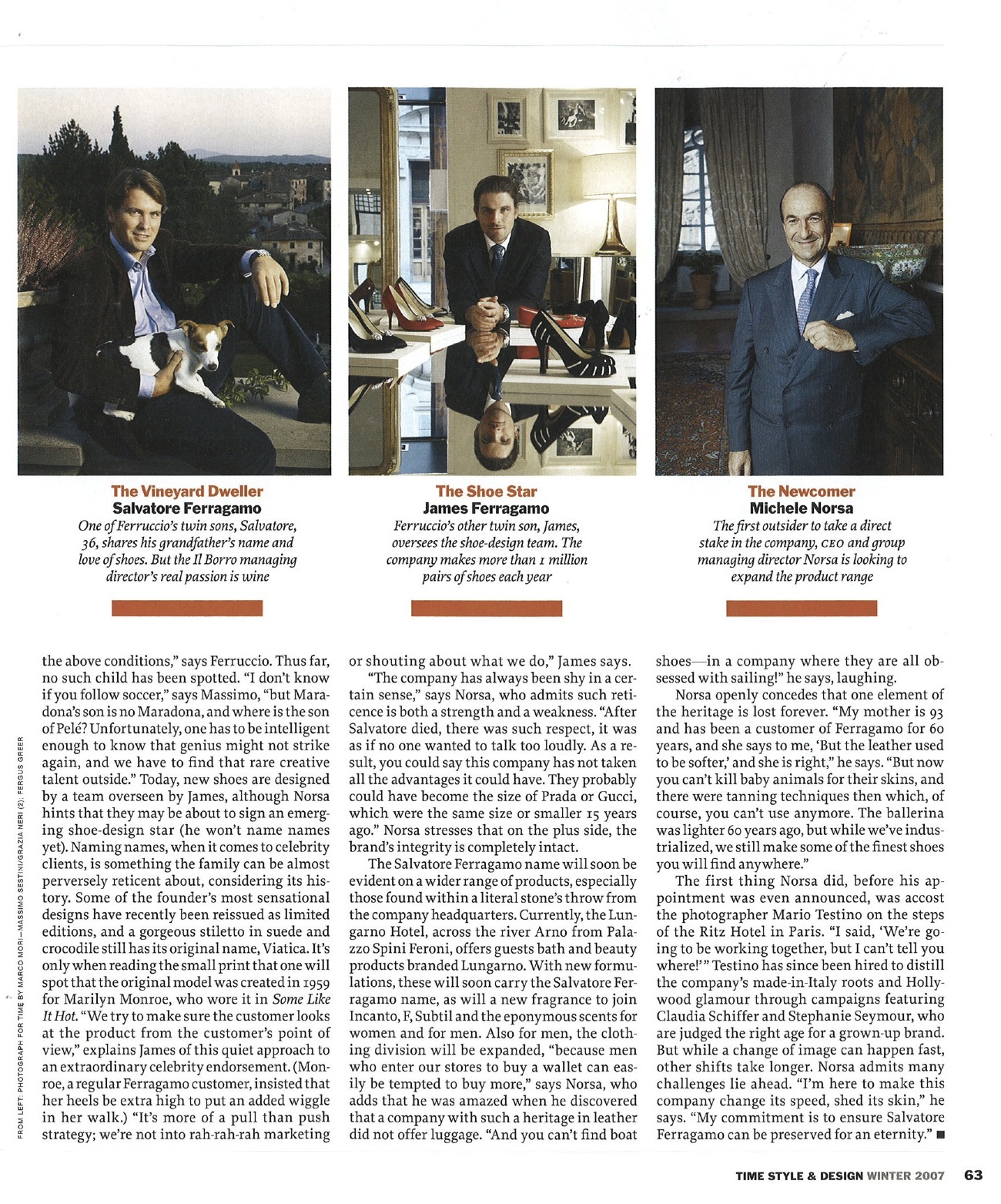
In fact, only two of the third generation are currently in the company:- 36-year-old James, one of Ferruccio’s twin sons (the other twin, named for the founder Salvatore, is managing director of Il Borro) and Angelica Visconti, aged 34, a retail manager in Italy, who is the daughter of Fulvia Visconti Ferragamo, who helms the accessories division. (The other sister of the second generation, Giovanna Gentile Ferragamo is vice-president of the Group holding company, ‘Ferragamo Finanziaria S.p.A). However, the rule book also has “genius clause” should anyone demonstrate the great creativity of the founder, in which case, “even if he or she didn’t know how to write, they could join with none of the above conditions,” says Ferruccio. Thus far, no such child has been spotted. “I don’t know if you follow soccer?” says Massimo, “but Maradona’s son is no Maradona and where is the son of Pelle? Unfortunately one has to be intelligent enough to know that genius might not strike again and we have to find that rare creative talent outside.” Today, new shoes are designed by a team overseen by James Ferragamo, although Michele Norsa hints that they may be about to sign an emerging shoe-design star (he won’t name names yet).
Naming names, when it comes to celebrity clients, is something the family can be almost perversely reticent about considering its history. Some of the founder’s most sensational designs have recently been reissued as limited editions and a gorgeous stiletto in gray suede and black calf still has its original name, Viatica. It’s only when one reads the small print that one spots the original model was created in 1958 for Marilyn Monroe, who wore the style in “Some Like it Hot”. “We try to make sure the customer looks at the product from the customer’s point of view,” explains James of this quiet approach to an extraordinary celebrity endorsement.” (Monroe, a regular Ferragamo customer, insisted her heels be extra high to put an added wiggle in her walk). “It’s more a pull than a push strategy, we’re not into ra-ra-ra marketing or shouting about what we do.”
“The company has always been shy in a certain sense,” says Michele Norsa, who admits such reticence is both a strength and a weakness. “After Salvatore died, there was such respect, it was as if no one wanted to talk too loud. As a result, you could say this company has not taken all the advantages it could. They probably could have become the size of Prada or Gucci, which were the same size or smaller 15 years ago.” However, Norsa stresses that on the plus side, the brand’s integrity is completely intact.
The Salvatore Ferragamo name will soon be more evident on a wider range of products, especially those found within, literally, a stone’s throw of the company HQ. Currently, the Lungarno Hotel, right across the river Arno from Palazzo Spini Feroni, offers guests excellent and generous bath and beauty products branded Lungarno. With new formulations, these will soon carry the Salvatore Ferragamo name, as will a new fragrance to join Incanto, F, Subtil and the eponymous scents for women and for men. Also for men, the clothing offer is to be expanded, “because men who enter our stores to buy a wallet can easily be tempted to more,” says Norsa, who adds he was amazed when he discovered that a company with such a heritage in leather does not yet offer luggage “and you can’t find boat shoes, in a company where they are all obsessed with sailing!” he laughs.
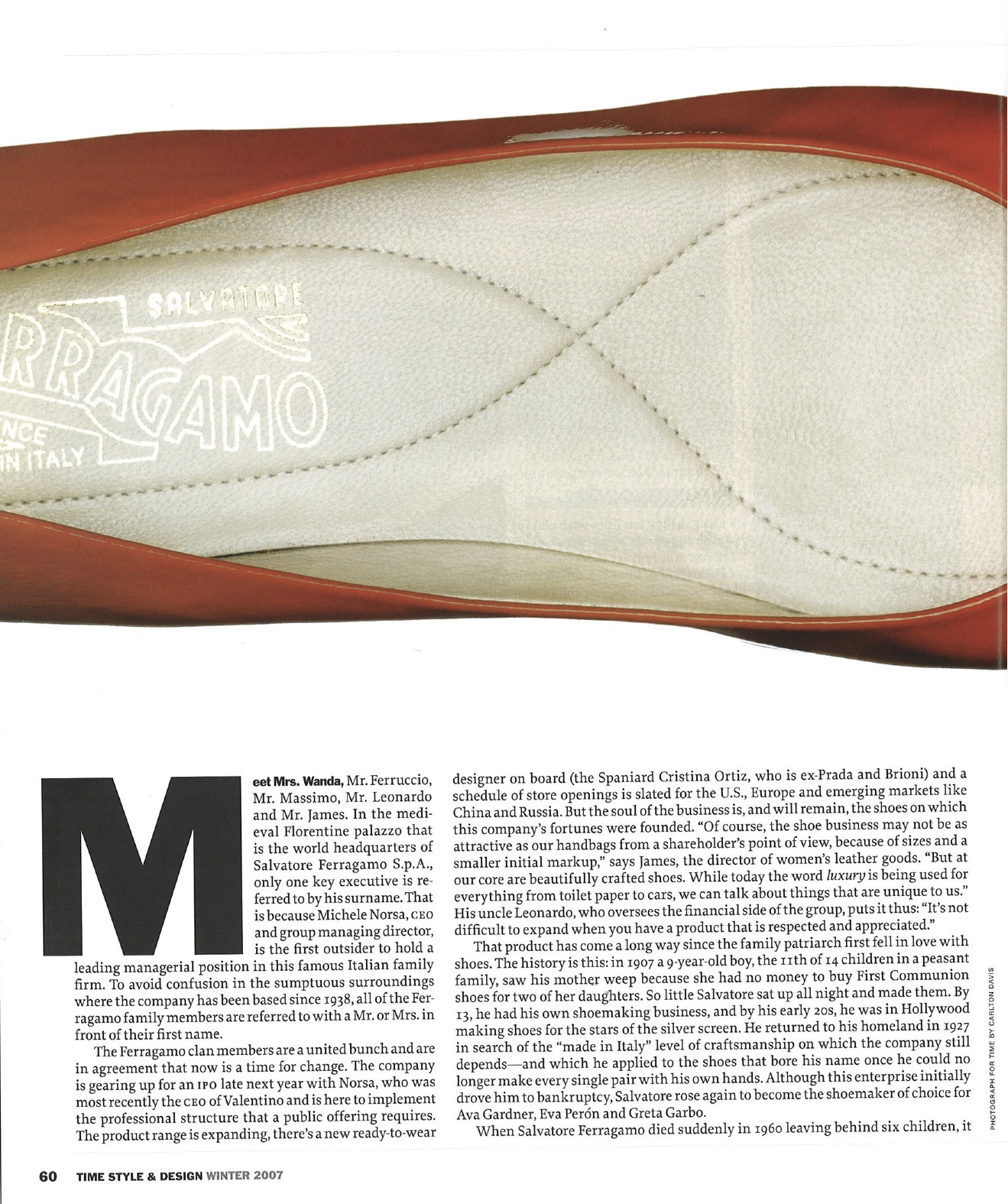
Norsa openly concedes that one element of the heritage is lost for ever. ‘My mother is 93 and has been a customer of Ferragamo for 60 years and she says to me “but the leather used to be softer” and she is right. But now you can’t kill baby animals for their skins and there were tanning techniques which of course you can’t use any more. The ballerina –was– lighter 60 years ago, but while of course we’ve industrialized, we still make some of the finest shoes you will find anywhere.”
The first thing Norsa did, before his appointment was even announced, was to accost the photographer, Mario Testino, on the steps of the Paris Ritz. “I said ‘We’re going to be working together but I can’t tell you where!’” Testino has since been hired to distill the company’s made-in-Italy roots and Hollywood glamour through campaigns featuring Claudia Schiffer and Stephanie Seymour, who are judged the right age for a grown-up brand. But while a change of image can happen fast, other shifts take longer. Norsa admits many challenges lie ahead. “I’m here to make this company change its speed, shed its skin. My commitment is to ensure Salvatore Ferragamo can be preserved for an eternity.”
Comments are closed, but trackbacks and pingbacks are open.