By Marion Hume
Every couple wants their honeymoon to be extraordinary. But what if time constraints, or maybe the fact you already have children at home, mean that you’ve only got is seven days? What if the idea of spending that on a distant beach doesn’t appeal at all?
May I suggest Beijing? We left London on a Wednesday afternoon and I had to be at my desk the following Wednesday morning. In between, the capital of The People’s Republic of China – an easy overnight direct flight from London – really did blow my mind.
As our hearts raced and our heads span due to an overdose of the unfamiliar and amazing, I quickly decided we’d got Stendhal Syndrome. The condition is named for the 19th century author who suffered an attack when exposed to the masterpieces of Florence, Italy. As for Beijing, which is a fascinating mix of the ancient and the new – and still in the process of bursting free from the repression of the past – the excitement is palpable.
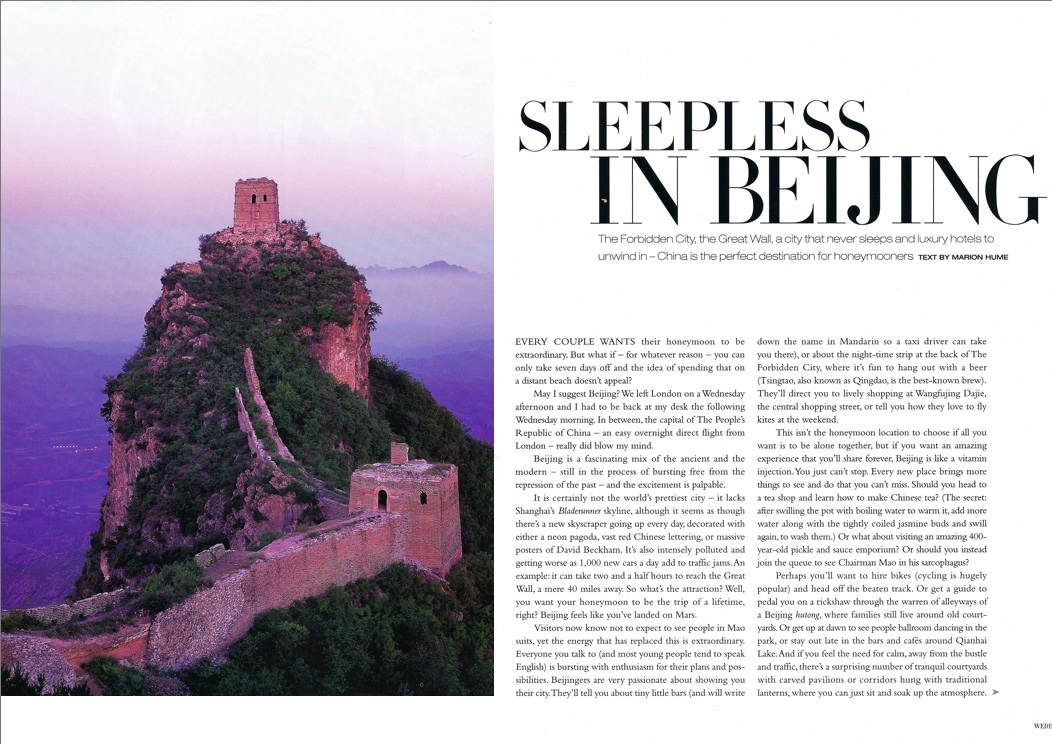
It is certainly not the world’s prettiest city (although there is beauty here). It lacks Shanghai’s Bladerunner skyline (although skyscrapers are going up at such a rate, it seems as if there’s a new one every day, each decorated with either a neon pagoda, vast red chinese lettering or, on several I saw, massive posters of David Beckham!). It’s fiercely polluted – and getting worse as 1,000 new cars a day add to traffic jams. Example: The Great Wall is 40 miles from Beijing. It can take two and a half hours, bumper-to-bumper, to get there. So what’s the attraction? Well, you want your honeymoon to be the trip of a lifetime, right? Beijing feels like you’ve landed on Mars.
Whatever you have read, it’s different. Visitors now know not to expect the downtrodden masses in Mao suits, yet the energy that has replaced this is still extraordinary. Everyone you talk to (and young people tend to speak serviceable English) is bursting with their plans and possibilities. They are quite curious about where you have come from but much more passionate to show you their city (Beijingers tend to be fiercely proud of living in the nation’s capital). They’ll tell you about tiny little bars (and will write down the name for you in Mandarin so a taxi driver can take you there), or about the night-time strip to the back of The Forbidden City, where it’s fun to hang out nursing a beer (Tsingtao, also known as Qingdao, is the best-known brew). They’ll direct you to lively shopping at Wangfunjing Dajie, the central shopping street, or tell you how they themselves love to fly kites (”Good for the neck and the eyes if you work on computers all week”) on the weekend.
This isn’t the honeymoon location to choose if you want is to be alone together but if, instead, you want an amazing experience that you’ll share forever, Beijing is like a vitamin injection. You can’t stop. Every new vista brings more things you just can’t miss. Should you head to a tea shop and learn how to make Chinese tea? (The secret, after swilling the pot with boiling water to warm it, you add more water along with the tightly coiled jasmine buds and swill again, to wash the leaves). Or what about an amazing 400 year old pickle and sauce emporium? Or should you instead join the queue to see Chairman Mao, pickled and in his sarcophagus (admission is free). Perhaps you want to hire
bikes (for people here do still ride bikes) and head off the beaten track? Or get someone else to peddle a rickshaw through the warren of alleyways of an old Beijing hutong, where families still live around old courtyards and you’d be lost in five minutes without a local guide? Should you get up at dawn to see people ballroom dancing in the park, or stay out late in the bars and cafes around Qianhai Lake? Or both? And if you feel the need for calm, despite the bustle and the traffic, there are a surprising number of tranquil courtyards, with carved pavillions or corridors hung with traditional lanterns where you can just sit, and watch the world.
Let’s start with the sights, the best known of which is, of course, The Forbidden City. I’d re-watched Bertolucci’s Oscar-sweeping classic, “The Last Emperor” , so I’d been reminded that “forbidden” referred to the 500 years when commoners entered on pain of death. As for “city”, it’s huge. Without stopping to take a photograph, it would take you an hour to walk straight through it, from the Meridian Gate to the Shenwu Gate. It could take you a day – or more – with an official guide, although that’s also because they insist on lecturing you about virtually every tile. Perhaps we missed key facts of Ming and Qing history by going it alone, but we could stand still and imagine Empress Cixi on her daybed. We could linger at the school house where an Englishman called Reginald Johnson taught a boy-emperor, who would end his life as a gardener, how to read.
Another must-see is the Temple of Heaven, even though, on our visit, the largest existant sacrificial temple in China was surrounded by scaffolding. Not being able to walk around it meant instead we walked in the park where a little boy started to sing before what we thought was a vast crowd; until the men to the left and the women to the right joined in with the chorus. The sound of this choir singing revolutionary-era songs was heart-rending.
Beijingers sing all the time. During the years of repression, where they wore the same clothes and ate the same meagre food, singing was, for many, the only chance to feel free. Make no mistake, this is still very much a communist country and with a lamentable record on human rights. Tourism is however, having the effect of eeking away at state censorship while the internet has proved hard to control. Everyone you’ll meet in Beijing will have an email address and a business card (always presented and taken with two hands) and these days – impossible until recent changes in laws on ownership – they might even own their own apartment.
Communism is now fused with vigourous capitalism, especially at the 1,600 stalls of the Silk Market, (famous these days not for silk, but for designer fakes). At time of writing, Prada, Gucci, Burberry, Vuitton and Chanel have banding together in a legal action against the counterfeiters, although few believe the sea of cheap imitations will dry up. But let the buyer beware: The “Timberland” boots and “North Face” jackets should certainly be left on the racks. Apparently the first are made of cardboard and the second aren’t even warm. That said, fashion people who own the real thing still come here to stock up on near-perfect fake Balenciaga lariat bags. If fakes aren’t your thing, go directly to the upper floors to find tempting vivid silk children’s wear, enticing scarves and wonderful little cheap trinkets from carved combs to traditional paper cut outs to Christmas decorations (despite being Communist, Christmas is big business with stalls groaning with jingle bells decorated with kitsch Chinese pandas).
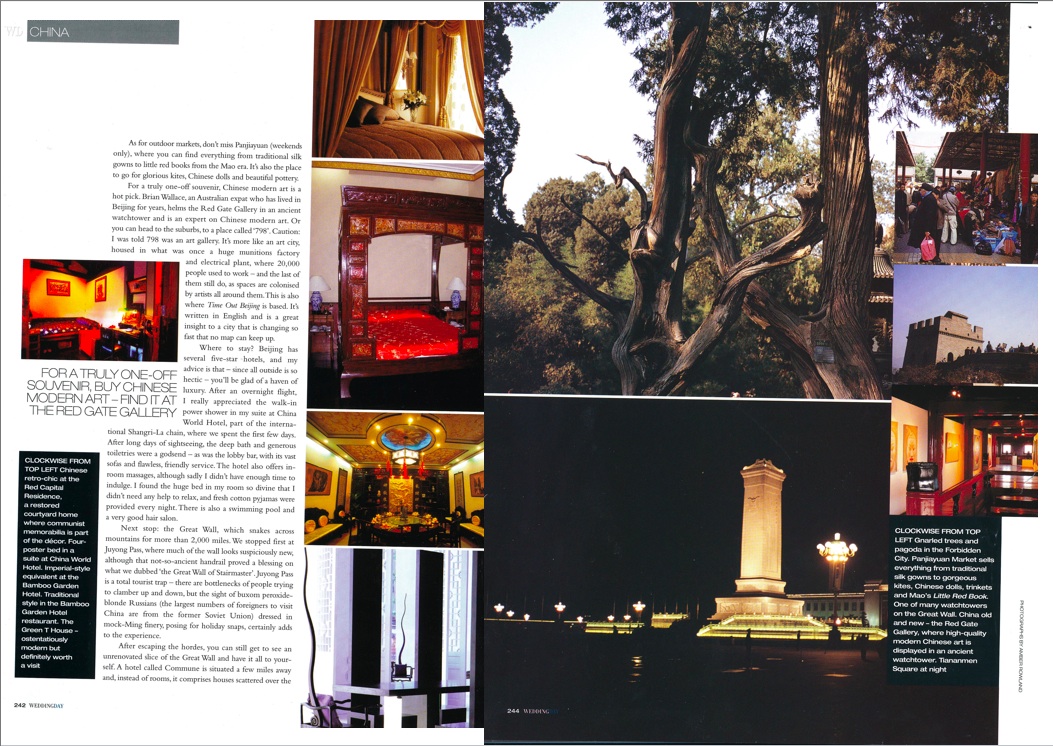
As for outdoor markets, do not miss Panjiayuan (weekends only), where you can find everything from traditional silk gowns to little red books from the Mao era. This is the place to find glorious kites, Chinese dolls and beautiful pieces of pottery.
For a truly one-off souvenir, Chinese modern art is a hot pick. Either go to the expert, Brain Wallace, an Australian, resident in Beijing for years, who helms Red Gate Gallery in ancient watchtower or head out to the suburbs to 798. A word of caution here. I was told 798 was an art gallery. It’s an art city, housed in what was once an enormous munitions factory and electrical plant, where 20,000 people used to work – and the last of them still do as spaces are colonised by artists all around them. This is also where Time Out Beijing is based. It’s written in English and is a great insight to a city that is changing so fast, no map can keep up.
Where to stay? Beijing has several luxurious five-star hotels and my advice is, as everything outside the doors is so different, you’ll be glad of a haven of normality (albeit very luxurious normality). After an overnight flight, I really appreciated the walk-in power shower in my suite at The China World, part of the international Shangri-la chain, where we spent the first few days. After long days of sight-seeing and before heading out for whatever adventure dinner might bring, the deep bath (and generous toiletries) was a godsend as was the lobby bar, with its vast sofas to curl up into and flawless, friendly service.
The hotel also offers in-room massages although I found I didn’t have time to partake of one! I found the huge bed in my room so divine I didn’t need any help to relax ( and fresh cotton pyjamas were provided every night) There is also a swimming pool and a very good hair salon here. What’s nice is that service is impeccable, without being cloying – when it came to room service, no one hovered waiting for a big tip, which I always find off-putting, especially first thing in the morning when I am in a hotel dressing gown!
Next, head out the Great Wall which snakes across mountains for over 2,000 miles. We stopped first at Juyong Pass, where much of the wall looks suspiciously new, (although that not-so-ancient hand rail proved a blessing on what we dubbed “the Great Wall of Stairmaster”). Juyong Pass is a tourist trap – literally; there are bottle necks of people trying to clamber up and down, but the sight of buxom peroxide blonde Russians (by far the largest numbers of foreigners to visit China are from the former Soviet Block) dressed up in Ming dynasty finery and posing for holiday snaps added to the experience.
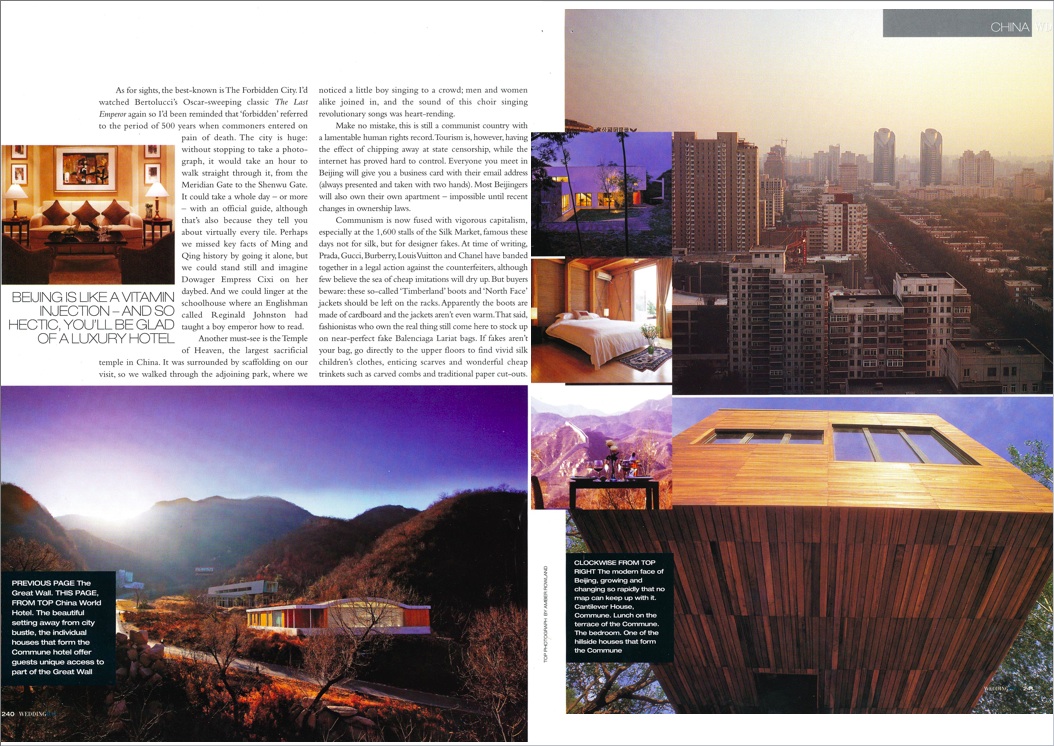
What’s magical is that on the same day, you can also have an unrenovated slice of the wall all to yourself. A few miles further on lies a hotel called Commune, where instead of rooms, there are houses scattered over the hillside. Staying here gives you unique access to a track up to “your own” slice of The Great Wall, along which you can scramble as it snakes for miles across the horizon. Commune is a must-see. Built originally as private houses, it is now managed by the Kempinski, the international luxury hotel chain. The Sichuan restaurant food is acknowledged as among the best in China and, a plus for 2006; they are currently building what promises to be Northern China’s most luxurious spa here. Be sure to check in for several days if you can. Once you’ve climbed the wall at a couple of locations, you’ll want to rest up and be cosseted (even if you do tell yourself you’re really staying on to study the architectural expressions of such Asian design stars as Hong Kong’s Gary Chang (responsible for Commune’s The Suitcase House), Taiwan’s Chien Hsueh-Yi (the evocatively named Airport House) or China’s Antonio Ochoa’s Cantilever House.)
Back in Beijing, we moved to more traditional lodgings at The Bamboo Garden, which is hidden down a back street in a “hutong”, one of the old courtyard communities that are fast disappearing under the bulldozer. Formerly the residence of a minister in the Qing Dynasty, I stayed in the grandest suite and can confirm even Empress Cixi would have approved of the imperial four poster.
Where to eat? Of course one must have Peking Duck. We were served it at a near-impossible-to-find Red Capital Club (our taxi driver was lost for half an hour) situated in another hutong. You can both eat and sleep at The Red Capital Club, amidst memorabilia that looks straight out of a communist museum. The concubine suite has its own courtyard.
For an extraordinary (and fiercely expensive) evening, try the Temple Kitchen, where reservations are essential. Be sure you understand the prices. Yes, that is shark’s fin soup and yes, that single bite of abalone is two hundred pounds sterling. Your taxi will stop in a little courtyard. It will be pitch dark, but for the light of a red lantern guiding you down an alleyway. Beyond ornate rooms, you can just make out the white dome of an 800 year old lama temple. You are being served from the kitchens of the emperors.
From the ancient to the modern, Green-T is all about the new China. Go for the scene, the hilariously-snotty waiting staff (I was warned it was “forbidden” to note down the items on the menu) and for the sheer lunacy of the food. I thought my “Field Dreams” (“honey mustard seed sauce on green pears sprinkled with hangzhou pecan walnuts and cheese”) which was served accompanied by a wizened stick was quite the silliest serving suggestion I’d ever come across — until the black sesame, green tea, jasmine and chestnut ice cream arrived in a steaming cauldron fit for Macbeth’s witches.
However, discovering your own places to eat in this city of a thousand choices is part of the thrill. One night, deep in a hutong, we feasted on sizzling beef and spicy aubergines at a tiny hole-in-the-wall. The bill was under three pounds for two.
When I set off for Beijing, I was slightly annoyed that I was unable, because of business commitments, to combine it with a trip to Shanghai. By the time I boarded to fly home, I was exhilarated but exhausted. I slept all the way and then set off to work after an unforgettable seven-day adventure.
ENDS


Comments are closed, but trackbacks and pingbacks are open.