HARPER’S BAZAAR | 2000
BYLINE: HUME, MARION
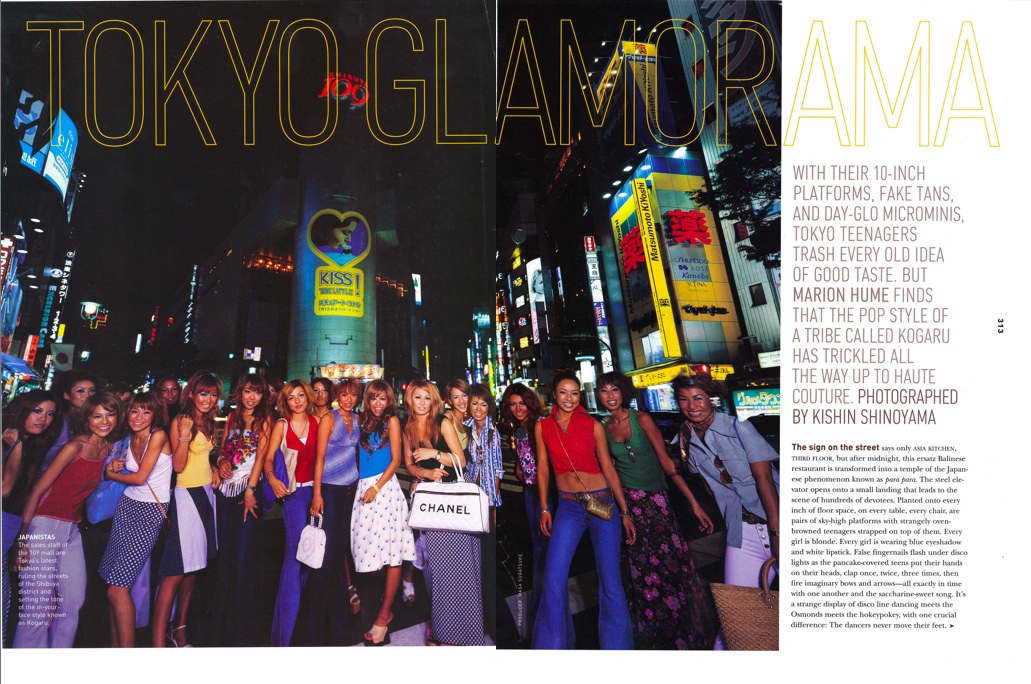
WITH THEIR 10-INCH PLATFORMS, FAKE TANS, AND DAY-GLO MICROMINIS, TOKYO TEENAGERS TRASH EVERY OLD IDEA OF GOOD TASTE. BUT MARION HUME FINDS THAT THE POP STYLE OF A TRIBE CALLED KOGARU HAS TRICKLED ALL THE WAY UP TO HAUTE COUTURE.
The sign on the street says only ASIA KITCHEN, THIRD FLOOR, but after midnight, this ersatz Balinese restaurant is transformed into a temple of the Japanese phenomenon known as para para. The steel elevator opens onto a small landing that leads to the scene of hundreds of devotees. Planted onto every inch of floor space, on every table, every chair, are pairs of sky-high platforms with strangely ovenbrowned teenagers strapped on top of them. Every girl is blonde. Every girl is wearing blue eyeshadow and white lipstick. False fingernails flash under disco lights as the pancake-covered teens put their bands on their heads, clap once, twice, three times, then fire imaginary bows and arrows–all exactly in time with one another and the saccharine-sweet song. It’s a strange display of disco line dancing meets the Osmonds meets the hokeypokey, with one crucial difference: The dancers never move their feet.
Center stage, up on a restaurant dining table, is one of the only boys in the room. All the girls are gazing at him with puppy love. He flashes a lazy, sexy smile now and then, but his arms never stop moving–a high-speed slap to the thigh here, a palm extended there–as he shifts from one quick-beat routine to the next. When his gaze rests on any one of the girls desperate to keep up with him, she swoons, wilts, then gets all hot and flustered in a way I thought had disappeared with David Cassidy’s career, But here, tonight, that kind of heartthrob lives on. He’s the leader of the para para.
That’s the name of the dance, and Kogaru–literally, “little girl”– is the name of the Tokyo tribe whose look requires hours in the tanning parlor, an even deeper shade of tan foundation, and–at its most extreme–blue contact lenses and a straw-yellow wig. We’re in the district of Shibuya–epicenter of this particular strain of girly materialism–where the Kogaru come by night to dance and by day to perch on the wall outside a mall called 109, which is filled to bursting with hot-pink hot pants, canary-yellow clam diggers, and boots with seven-inch heels that even Nancy Sinatra would find challenging. Before the Kogaru shop, they apply more makeup, adding still more frosting to huge white panda rings under long false lashes, while looking into mirrors so big other women would nail them to a bathroom wall, not carry them around in a Louis Vuitton tote.
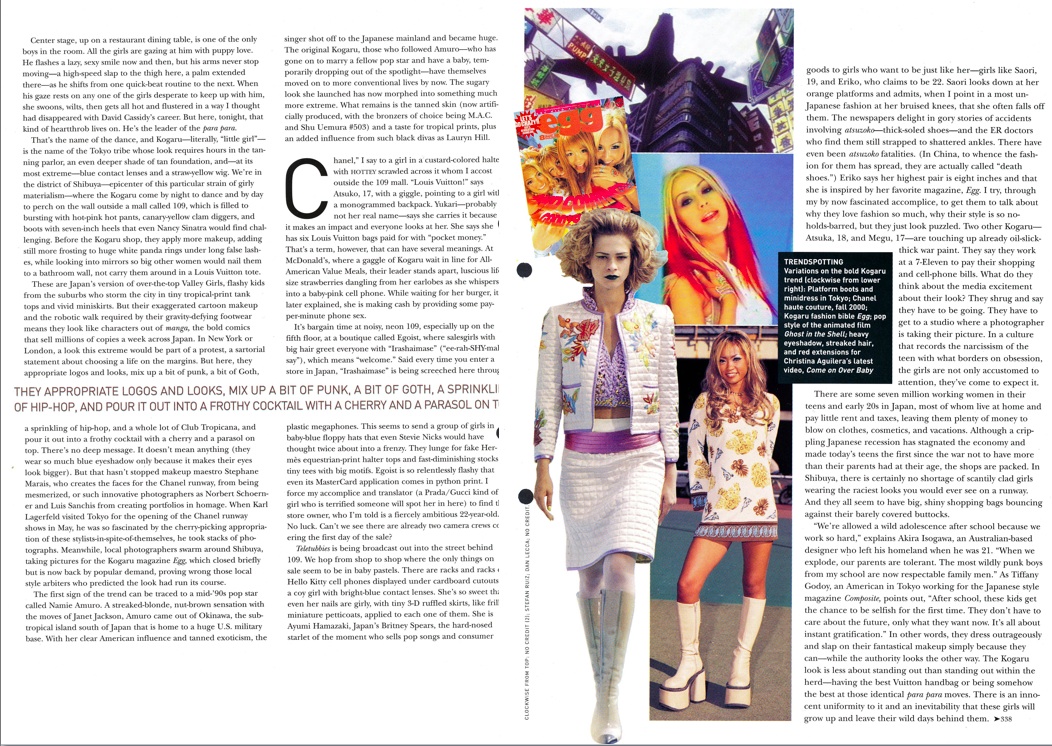
These are Japan’s version of over-the-top Valley Girls, flashy kids from the suburbs who storm the city in tiny tropical-print tank tops and vivid miniskirts. But their exaggerated cartoon makeup and the robotic walk required by their gravity-defying footwear means they look like characters out of manga, the bold comics that sell millions of copies a week across Japan. In New York or London, a look this extreme would be part of a protest, a sartorial statement about choosing a life on the margins. But here, they appropriate logos and looks, mix up a bit of punk, a bit of Goth, a sprinkling of hip-hop, and a whole lot of Club Tropicana, and pour it out into a frothy cocktail with a cherry and a parasol on top. There’s no deep message. It doesn’t mean anything (they wear so much blue eyeshadow only because it makes their eyes look bigger). But that hasn’t stopped makeup maestro Stephane Marais, who creates the faces for the Chanel runway, from being mesmerized, or such innovative photographers as Norbert Schoer ner and Luis Sanchis from creating portfolios in homage. When Karl Lagerfeld visited Tokyo for the opening of the Chanel runway shows in May, he was so fascinated by the cherry-picking appropriation of these stylists-in-spite-of-themselves, he took stacks of photographs. Meanwhile, local photographers swarm around Shibuya, taking pictures for the Kogaru magazine Egg, which closed briefly but is now back by popular demand, proving wrong those local style arbiters who predicted the look had run its course.
The first sign of the trend can be traced to a mid-’90s pop star called Namie Amuro. A streaked-blonde, nut-brown sensation with the moves of Janet Jackson, Amuro came out of Okinawa, the subtropical island south of Japan that is home to a huge U.S. military base. With her clear American influence and tanned exoticism, the singer shot off to the Japanese mainland and became huge. The original Kogaru, those who followed Amuro–who has gone on to marry a fellow pop star and have a baby, temporarily dropping out of the spotlight–have themselves moved on to more conventional lives by now. The sugary look she launched has now morphed into something much more extreme. What remains is the tanned skin (now artificially produced, with the bronzers of choice being M.A.C. and Shu Uemura #503) and a taste for tropical prints, plus an added influence from such black divas as Lauryn Hill.
Chanel,” I say to a girl in a custard-colored halter with HOTTEY scrawled across it whom I accost outside the 109 mall. “Louis Vuitton!” says Atsuko, 17, with a giggle, pointing to a girl with a monogrammed backpack. Yukari–probably not her real name–says she carries it because it makes an impact and everyone looks at her. She says she has six Louis Vuitton bags paid for with “pocket money.” That’s a term, however, that can have several meanings. At McDonald’s, where a gaggle of Kogaru wait in line for All American Value Meals, their leader stands apart, luscious life-size strawberries dangling from her earlobes as she whispers into a baby-pink cell phone. While waiting for her burger, it is later explained, she is making cash by providing some pay-per-minute phone sex.
It’s bargain time at noisy, neon 109, especia1ly up on the fifth floor, at a boutique called Egoist, where salesgirls with big hair greet everyone with “Irashaimase” (“ee-rah-SHY-mah say”), which means “welcome.” Said every time you enter a store in Japan, “Irashaimase” is being screeched here through plastic megaphones. This seems to send a group of girls in baby-blue floppy hats that even Stevie Nicks would have thought twice about into a frenzy. They lung for fake Hermes equestrian-print halter tops and fast-diminishing stocks of tiny tees with big motifs. Egoist is so relentlessly flashy that even its MasterCard application comes in python print. I force my accomplice and translator (a Prada/ Gucci kind of girl who is terrified someone will spot her in ere) to find the store owner, who I’m told is a fiercely ambitious 22-year-old. No luck. Can’t we see there are already two camera crews covering the first day of the sale?
Teletubbies is being broadcast out into the street behind 109. We hop from shop to shop where the only things on sale seem to be in baby pastels. There are racks and racks of Hello Kitty cell phones displayed under cardboard cutouts of a coy girl with bright-blue contact lenses. She’s so sweet that even her nails are girly, with tiny 3-D ruffled skirts, like frilly miniature petticoats, applied to each one of them. She is Ayumi Hamazaki, Japan’s Britney Spears, the hard-nosed starlet of the moment who sells pop songs and consumer goods to girls who want to be just like her–girls like Saori, 19, and Eriko, who claims to be 22. Saori looks down at her orange platforms and admits, when I point in a most un-Japanese fashion at her bruised knees, that she often falls off them. The newspapers delight in gory stories of accidents involving atsuzoko–thick-soled shoes–and the ER doctors who find them still strapped to shattered ankles. There have even been atsuzoko fatalities. (In China, to whence the fashion for t hem has spread, they are actually called “death shoes.”) Eriko says her highest pair is eight inches and that she is inspired by her favorite magazine, Egg. I try, through my by now fascinated accomplice, to get them to talk about why they love fashion so much, why their style is so no-bolds-barred, but they just look puzzled. Two other Kogaru–Atsuka, 18, and Megu, 17–are touching up already oil-slick-thick war paint. They say they work at a 7-Eleven to pay their shopping and cell-phone bills. What do they think about the media excitement about their look? They shrug and say they have to be going. They have to get to a studio where a photographer is taking their picture. In a culture that records the narcissism of the teen with what borders on obsession, the girls are not only accustomed to attention, they’ve come to expect it.
There are some seven million working women in their teens and early 20s in Japan, most of whom live at home and pay little rent and taxes, leaving them plenty of money to blow on clothes, cosmetics, and vacations. Although a crippling Japanese recession has stagnated the economy and made today’s teens the first since the war not to have more than their parents had at their age, the shops are packed. In Shibuya, there is certainly no shortage of scantily clad girls wearing the raciest looks you would ever see on a runway. And they all seem to have big, shiny shopping bags bouncing against their barely covered buttocks.
“We’re allowed a wild adolescence after school because we work so hard,” explains Akira Isogawa, an Australian-based designer who left his homeland when he was 21. “When we explode, our parents are tolerant. The most wildly punk boys from my school are now respectable family men.” As Tiffany Godoy, an American in Tokyo working for the Japanese style magazine Composite, points out, “After school, these kids get the chance to be selfish for the first time. They don’t have to care about the future, only what they want now. It’s all about instant gratification.” In other words, they dress outrageously and slap on their fantastical makeup simply because they can–while the authority looks the other way. The Kogaru look is less about standing out than standing out within the herd–having the best Vuitton handbag or being somehow the best at those identical para para moves. There is an innocent uniformity to it and an inevitability that these girls will grow up and leave their wild days behind them.
But things only seem innocent in Tokyo, a city where people are so polite that they hand you tissues on the subway and the taxi drivers wear white gloves and refuse to let you leave a tip. “In Japan, it is all about appearance, not rebellion,” says Isogawa when I give him a bunch of magazines, including Egg and its copycat, Ego. “You’ll love them,” I say. “They are full of these frenzied teenage consumers posing in their new clothes and acting out hilarious dance steps they do without moving their unbelievable wedge shoes!”
A week later, Isogawa calls and suggests we meet not in his busy design studio but at the cafe up the street. “It’s a long time since I left Japan,” he says, covering his face with his hand. “I’ve translated the magazines for you. What she is saying,” he says, pointing to a picture of a smiling, shopping, carefree teen, “is that she likes a vibrator that’s only nine centimeters so she, can use it on the train.” I nearly choke on my caffe latte. “Here,” he says, pointing at a grinning puppet, she is saying that her boyfriend’s penis reminds her of an expensive Japanese mushroom.” He goes on and on, painstakingly translating as he had promised, even though by this point I’m staring at him in disbelief.
So a memo to Karl Lagerfeld, who stockpiles so many magazines from around the globe that his studio looks like a newsstand: The ones you brought back from Japan might not be quite what you think. Memo to those new-wave designers, like Veronique Branquinho, Hussein Chalayan, and Nicolas Ghesquiere of Balenciaga, for whom Japan is the most important market: It isn’t always as cute as it looks. Not that anyone should miss the chance to go to a para para club with the Kogaru. It’s just that, well, those glistening, joyous girls aren’t, after all, thinking quite the way I used to about David Gassidy.
Contributing editor Marion Hume traveled to Tokyo to report on the Kogaru–teenage girls whose outrageous, cartoonlike style is influencing fashion runways and music videos “They wear hot pants so short and colors so bright, even Donatella Versace would put on shades,” says the Sydney-based journalist. “I laughed when I saw their flame-orange, plastic platform shoes, and they would look down at my flat shoes and laugh right back.”