Harper’s Bazaar | 1 February 2000
By Marion Hume
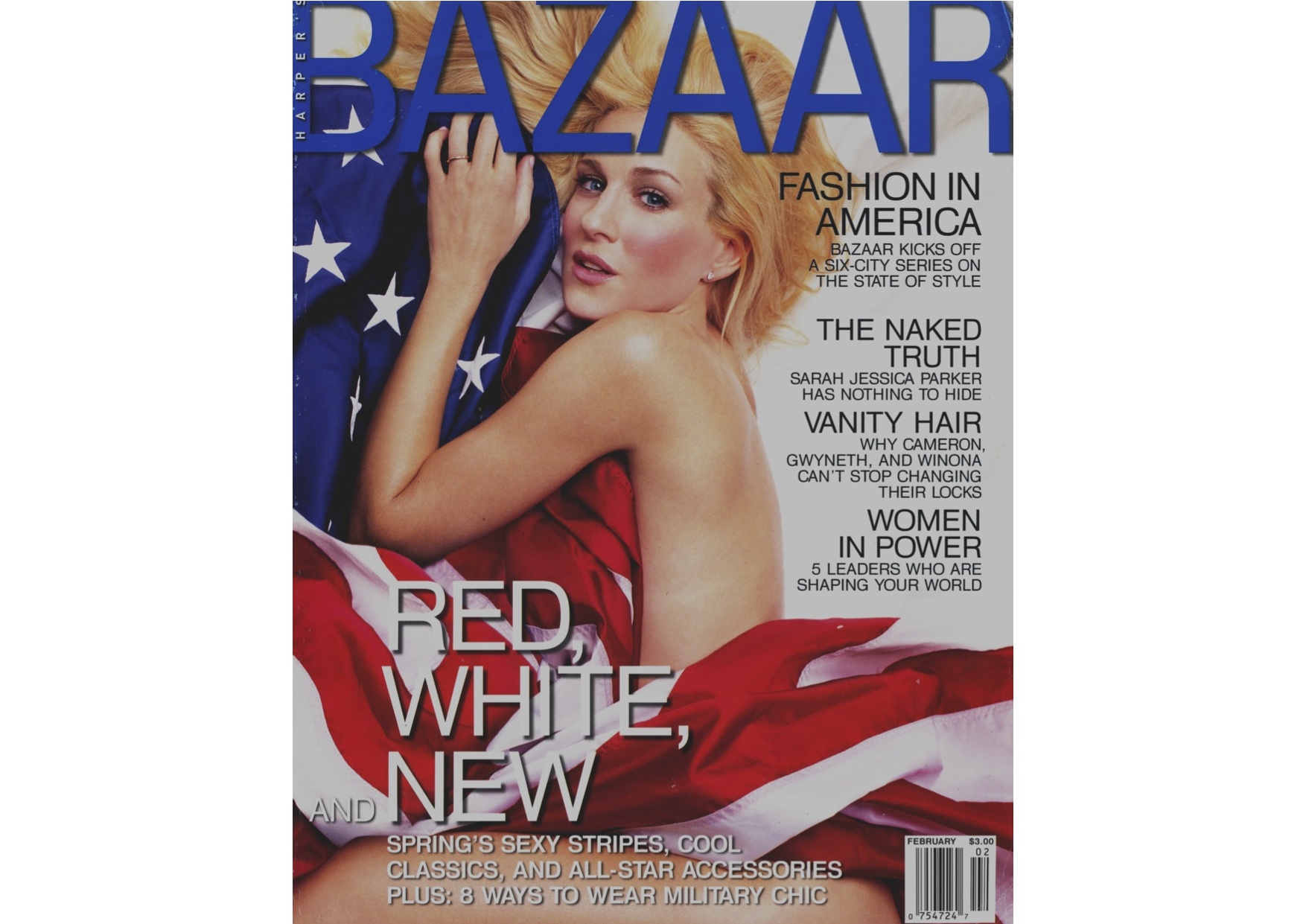
HE’S NEVER HAD JUST ONE MOMENT. BUT THIS SEASON, RALPH LAUREN, FASHION’S PERENNIAL DESIGNER, IS HAVING HIS PRAISES SUNG BY THE AVANT-GARDE’S ANGELS– MIGUEL AD ROVER AND NICOLAS GHESQUIERE. MARION HUME SITS DOWN WITH PREPPY’S FOUNDING FATHER.
Remember when you first saw Billy Bass and thought for a minute that a singing fish was cute? So did Dylan Lauren, and she bought one for her dad. That he displays it in his office makes him just like other dads who adore cheesy gifts from their kids–except he’s Ralph Lauren.
Can you imagine walking into Calvin Klein’s office and finding a plastic fish on the steel desk? Can you imagine popping downtown to Marc Jacobs’s studio and seeing a motion-activated bass nailed to his off-white wall? It’s a shock to spot Billy in the den of a man who has, after all, spent 34 years peddling fantasies staged in perfect houses full of silver-framed photos of people with great hair. In Ralph Lauren’s world, you expect antique inkwells, willow cricket bats, and mounted trophies of stags or marlin–not a fish that fixes you with a plastic eye, flips forward, and sings “Don’t Worry, Be Happy.”
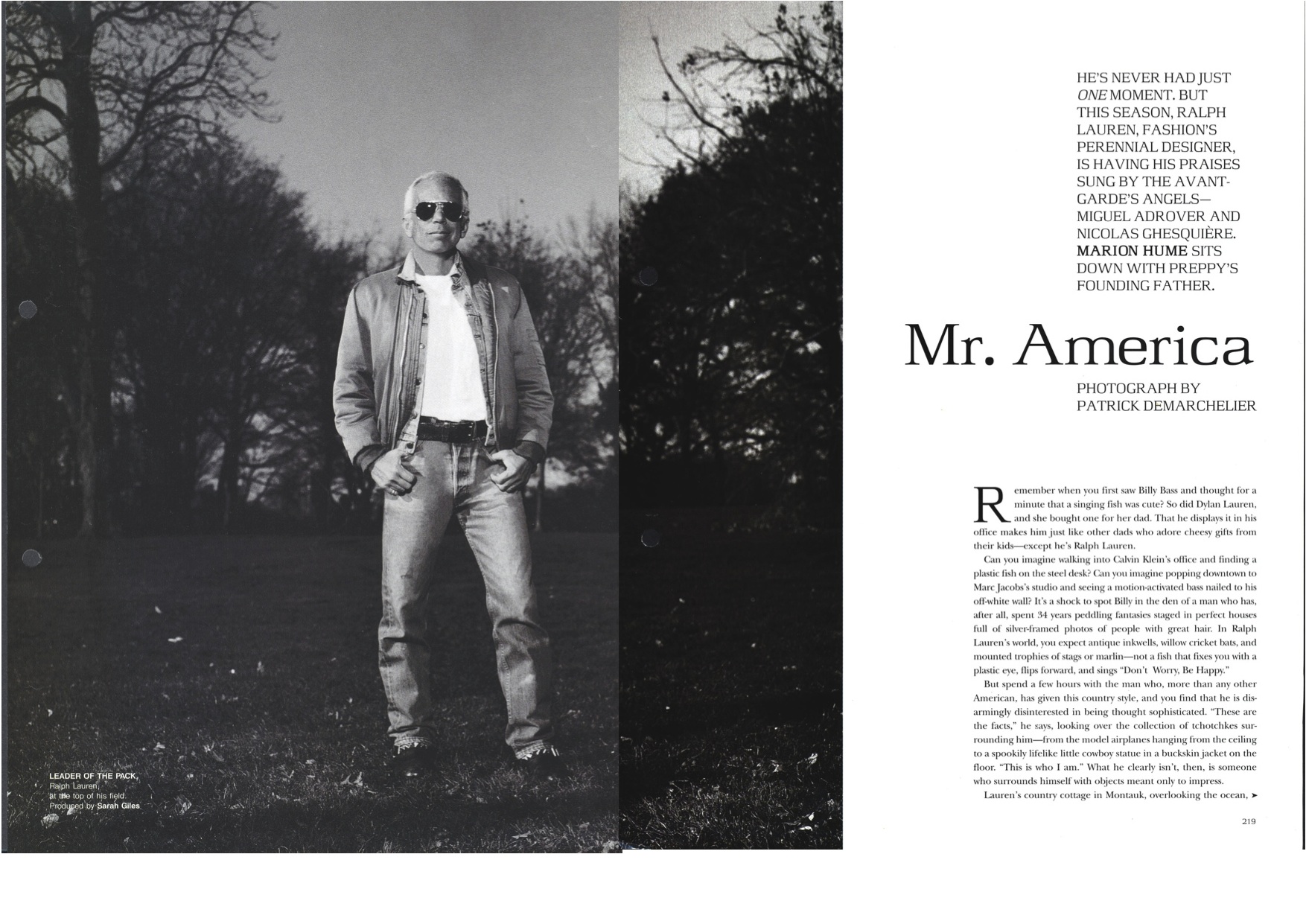
But spend a few hours with the man who, more than any other American, has given this country style, and you find that he is disarmingly disinterested in being thought sophisticated. “These are the facts,” he says, looking over the collection of tchotchkes surrounding him–from the model airplanes hanging from the ceiling to a spookily lifelike little cowboy statue in a buckskin jacket on the floor. “This is who I am.” What he clearly isn’t, then, is someone who surrounds himself with objects meant only to impress.
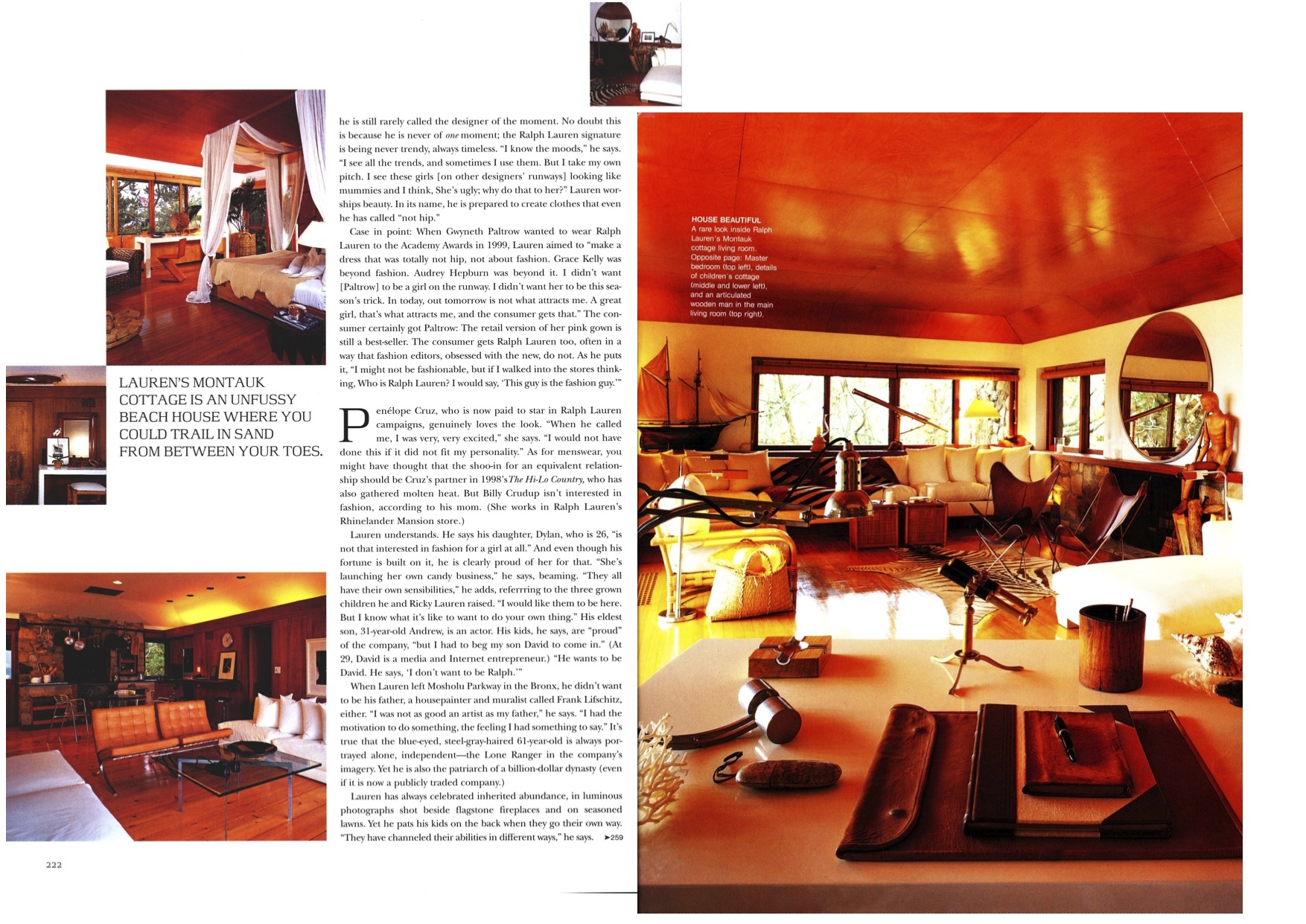
Lauren’s country cottage in Montauk, overlooking the ocean, is also surprisingly modest. Indeed, all five of his homes (except the stone mansion in Bedford, NY) are on a smaller scale than one might expect, given the implied opulence of his advertising imagery. “It’s not going to knock your socks off. It’s not majestic,” says Lauren. “We rented it before we could afford to buy it. John and Yoko rented it, Barbra Streisand rented it, Diana Ross, Leonard Bernstein; they all rented it.” Since those days, a huge gym has been built, but the cottage itself, with its polished bare floorboards and white slipcovered sofas, still looks like an unfussy beach house where you could trail in sand from between your toes.
“It has a mood; it doesn’t dazzle,” says Lauren, who doesn’t dazzle either. “I don’t own any paintings by Picasso. I like this,” he says of a sweeping sketch in his office by an unknown artist. “There’s a cowboy. There’s a horse. I’m inspired by the saddle, the guy, the hat. It feeds me on a lot of levels.”
Yet this is a man who’s had a dazzlingly far-reaching effect on fashion. It would be no exaggeration to claim that Ralph Lauren is Mr. America of style, that he has imbued this country with much of its sartorial vocabulary. The appeal of the mallet-swinging polo-player logo is understood from Madison Avenue to Main Street, from Harlem to the Hamptons. It speaks alike to socialites, sports fans, street kids, and now, surfers of Polo.com. “Brad Pitt told me he grew up in it,” the designer notes. And the Kickapoo High School student turned Hollywood heartthrob wears Ralph Lauren still.
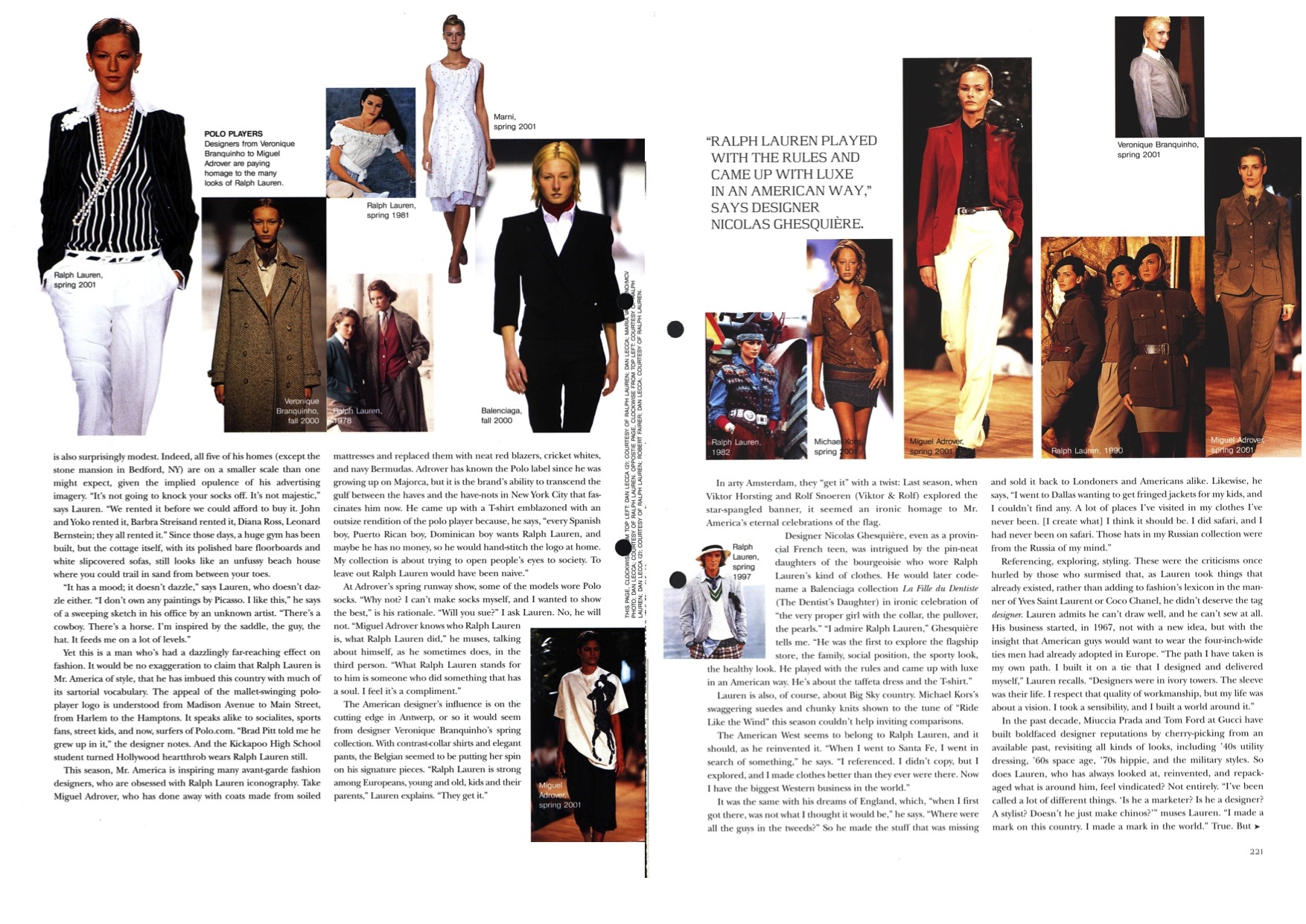
This season, Mr. America is inspiring many avant-garde fashion designers, who are obsessed with Ralph Lauren iconography. Take Miguel Adrover, who has done away with coats made from soiled mattresses and replaced them with neat red blazers, cricket whites, and navy Bermudas. Adrover has known the Polo label since he was growing up on Majorca, but it is the brand’s ability to transcend the gulf between the haves and the have-nots in New York City that fascinates him now. He came up with a T-shirt emblazoned with an outsize rendition of the polo player because, he says, “every Spanish boy, Puerto Rican boy, Dominican boy wants Ralph Lauren, and maybe he has no money, so he would hand-stitch the logo at home. My collection is about trying to open people’s eyes to society. To leave Out Ralph Lauren would have been naive.”
At Adrover’s spring runway show, some of the models wore Polo socks. “why not? I can’t make socks myself, and I wanted to show the best,” is his rationale. “Will you sue?” I ask Lauren. No, he will not. “Miguel Adrover knows who Ralph Lauren is, what Ralph Lauren did,” he muses, talking about himself, as he sometimes does, in the third person. “What Ralph Lauren stands for to him is someone who did something that has a soul. I feel it’s a compliment.”
The American designer’s influence is on the cutting edge in Antwerp, or so it would seem from designer Veronique Branquinho’s spring collection. With contrast-collar shirts and elegant pants, the Belgian seemed to be putting her spin on his signature pieces. “Ralph Lauren is strong among Europeans, young and old, kids and their parents,” Lauren explains. “They get it.”
In arty Amsterdam, they “get it” with a twist: Last season, when Viktor Horsting and Rolf Snoeren (Viktor & Rolf) explored the star-spangled banner, it seemed an ironic homage to Mr. America’s eternal celebrations of the flag.
Designer Nicolas Ghesquiere, even as a provincial French teen, was intrigued by the pin-neat daughters of the bourgeoisie who wore Ralph Lauren’s kind of clothes. He would later codename a Balenciaga collection La File du Dentiste (The Dentist’s Daughter) in ironic celebration of “the very proper girl with the collar, the pullover, the pearls.” “I admire Ralph Lauren,” Ghesquiere tells me. “He was the first to explore the flagship store, the family, social position, the sporty look, the healthy look. He played with the rules and came up with luxe in an American way. He’s about the taffeta dress and the T-shirt.”
Lauren is also, of course, about Big Sky country. Michael Kors’s swaggering suedes and chunky knits shown to the tune of “Ride Like the Wind” this season couldn’t help inviting comparisons.
The American West seems to belong to Ralph Lauren, and it should, as he reinvented it. “When I went to Santa Fe, I went in search of something,” he says. “I referenced. I didn’t copy, but I explored, and I made clothes better than they ever were there. Now I have the biggest Western business in the world.”
It was the same with his dreams of England, which, “when I first got there, was not what I thought it would be,” he says. “Where were all the guys in the tweeds?” So he made the stuff that was missing and sold it back to Londoners and Americans alike. Likewise, he says, “I went to Dallas wanting to get fringed jackets for my kids, and I couldn’t find any. A lot of places I’ve visited in my clothes I’ve never been. [I create what] I think it should be. I did safari, and I had never been on safari. Those bats in my Russian collection were from the Russia of my mind.”
Referencing, exploring, styling. These were the criticisms once hurled by those who surmised that, as Lauren took things that already existed, rather than adding to fashion’s lexicon in the manner of Yves Saint Laurent or Coco Chanel, he didn’t deserve the tag designer. Lauren admits he can’t draw well, and he can’t sew at all. His business started, in 1967, not with a new idea, but with the insight that American guys would want to wear the four-inch-wide ties men had already adopted in Europe. “The path I have taken is my own path. I built it on a tie that I designed and delivered myself,” Lauren recalls. “Designers were in ivory towers. The sleeve was their life. I respect that quality of workmanship, but my life was about a vision. I took a sensibility, and I built a world around it.”
In the past decade, Miuccia Prada and Tom Ford at Gucci have built boldfaced designer reputations by cherry-picking from an available past, revisiting all kinds of looks, including ’40s utility dressing, ’60s space age, ’70s hippie, and the military styles. So does Lauren, who has always looked at, reinvented, and repackaged what is around him, feel vindicated? Not entirely. “I’ve been called a lot of different things. ‘Is he a marketer? Is he a designer? A stylist? Doesn’t he just make chinos?’” muses Lauren. “I made a mark on this country. I made a mark in the world.” True. But he is still rarely called the designer of the moment. No doubt this is because he is never of one moment; the Ralph Lauren signature is being never trendy, always timeless. “I know the moods,” he says. “I see all the trends, and sometimes I use them. But I take my own pitch. I see these girls [on other designers' runways] looking like mummies and I think, She’s ugly; why do that to her?” Lauren worships beauty. In its name, he is pr epared to create clothes that even he has called “not hip.”
Case in point: When Gwyneth Paltrow wanted to wear Ralph Lauren to the Academy Awards in 1999, Lauren aimed to “make a dress that was totally not hip, not about fashion. Grace Kelly was beyond fashion. Audrey Hepburn was beyond it. I didn’t want [Paltrow] to be a girl on the runway. I didn’t want her to be this season’s trick. In today, out tomorrow is not what attracts me. A great girl, that’s what attracts me, and the consumer gets that.” The consumer certainly got Paltrow: The retail version of her pink gown is still a best-seller. The consumer gets Ralph Lauren too, often in a way that fashion editors, obsessed with the new, do not. As he puts it, “I might not be fashionable, but if I walked into the stores thinking, Who is Ralph Lauren? I would say, ‘This guy is the fashion guy.’”
Penelope Cruz, who is now paid to star in Ralph Lauren campaigns, genuinely loves the look. “When he called me, I was very, very excited,” she says. “I would not have done this if it did not fit my personality.” As for menswear, you might have thought that the shoo-in for an equivalent relationship should be Cruz’s partner in 1998′s The Hi-Lo Country, who has also gathered molten heat. But Billy Crudup isn’t interested in fashion, according to his mom. (She works in Ralph Lauren’s Rhinelander Mansion store.)
Lauren understands. He says his daughter, Dylan, who is 26, “is not that interested in fashion for a girl at all.” And even though his fortune is built on it, he is clearly proud of her for that. “She’s launching her own candy business,” he says, beaming. “They all have their own sensibilities,” be adds, referrring to the three grown children he and Ricky Lauren raised. “I would like them to be here. But I know what it’s like to want to do your own thing.” His eldest son, 31-year-old Andrew, is an actor. His kids, he says, are “proud” of the company, “but I had to beg my son David to come in.” (At 29, David is a media and Internet entrepreneur.) “He wants to be David. He says, ‘I don’t want to be Ralph.’”
When Lauren left Mosholu Parkway in the Bronx, he didn’t want to be his father, a housepainter and muralist called Frank Lifschitz, either. “I was not as good an artist as my father,” he says. “I had the motivation to do something, the feeling I had something to say.” It’s true that the blue-eyed, steel-gray-haired 61-year-old is always portrayed alone, independent–the Lone Ranger in the company’s imagery. Yet he is also the patriarch of a billion-dollar dynasty (even if it is now a publicly traded company.)
Lauren has always celebrated inherited abundance, in luminous photographs shot beside flagstone fireplaces and on seasoned lawns. Yet he pats his kids on the back when they go their own way. “They have channeled their abilities in different ways,” he says.
Where will Lauren’s own abilities be channeled next? “What do I say I didn’t say before?” asks the designer who, perhaps uniquely among his peers, does not try to erase all reference to the fact that he is no longer young. The word Lauren uses to describe himself right now is happy. “I’ve had great success,” he says. “I have expressed myself and found rewards beyond my dreams.”
The only thing he seems not very happy about is how he is going to sound in this article. Face-to-face, Lauren is raw and honest. But he knows from experience that utterances such as “I’m like Rocky” (which slipped out during our interview) sound silly in print, and so he qualifies them: “No, not Rocky. Who do I see myself as?”
As for Bazaar’s name for him, “Mr. America,” he says, “Do I want to be heralded as ‘Mr. America’? I don’t know if that’s cool. I think it’s pretty good, but will it read well? ‘Ralph Lauren thinks he’s Mr. America’? Doesn’t it sound too much? Don’t let it sound too much. It’s amazing, but my goal was always to be myself.
“Treat me with integrity,” he implores. “I feel there’s a lot of integrity in what I do. I like who I am, not because I think I’m a genius, but because I like my sense of what I feel inside. I think I’ve helped to lift America up. I have looked at our culture, the West, the Adirondacks, the character, and I have represented it in a way that makes one proud of its excitement and beauty. Write about that.”
I just have. But I will end with what I think is true, which is that while Billy Bass is incredibly uncool, a man has integrity if he cares more about gifts from people he loves than what a reporter might surmise based on seeing them. To dare to he a romantic in a cynical business, to go against the grain, to forge your own track-I think Mr. America would do that.


Comments are closed, but trackbacks and pingbacks are open.